
|
You entered: color
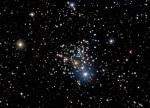 NGC 2266: Old Cluster in the New General Catalog
1.06.2002
The New General Catalog of star clusters and nebulae really isn't so new. In fact, it was published in 1888 - an attempt by J. L. E. Dreyer to consolidate the work of astronomers William, Caroline, and John Herschel along with others into a useful single, complete catalog of astronomical discoveries and measurements.
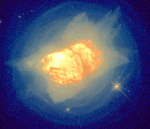 NGC 7027: A Dying Star's Nebula
17.01.1996
This pseudo-color composite of two recent Hubble Space Telescope images is a picture of a Sun-like star nearing the end of its lifetime. The exquisite details visible in this planetary nebula indicate that when...
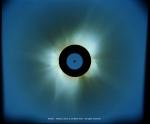 The Crown of the Sun
13.12.2002
During a total solar eclipse, the Sun's extensive outer atmosphere or corona is an awesome and inspirational sight. Yet the subtle shades and shimmering features of the corona that engage the eye span a brightness range of over 10,000 to 1, making them notoriously difficult to capture in a photograph.
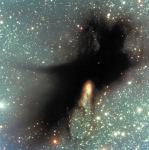 BHR 71: Stars, Clouds, and Jets
27.01.2003
What is happening to molecular cloud BHR 71? Quite possible, a binary star system is forming inside. Most stars in our Galaxy are part of binary star systems, but few have ever been seen in formation.
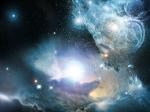 A Primodrial Quasar
20.05.2003
What did the first quasars look like? The nearest quasars are now known to be supermassive black holes in the centers of galaxies. Gas and dust that falls toward a quasar glows brightly, sometimes outglowing the entire home galaxy.
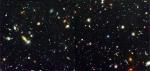 The Hubble Deep Field
7.06.1998
Galaxies like colorful pieces of candy fill the Hubble Deep Field - humanity's most distant yet optical view of the Universe. The dimmest, some as faint as 30th magnitude (about four billion times fainter...
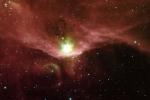 Sharpless 140
20.05.2004
Three young, massive stars will eventually emerge from this natal cloud of dust and gas, but their presence is already revealed in this false-color image from the Spitzer Space Telescope. The picture offers...
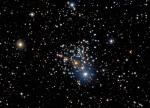 NGC 2266: Old Cluster in the New General Catalog
19.03.2005
The New General Catalog of star clusters and nebulae really isn't so new. In fact, it was published in 1888 - an attempt by J. L. E. Dreyer to consolidate the work of astronomers William, Caroline, and John Herschel along with others into a useful single, complete catalog of astronomical discoveries and measurements.
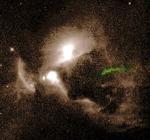 A Disk and Jet in Haro 6-5B
11.02.1999
Planets condense from disks. Several new Hubble Space Telescope pictures of stars surrounded by disks were released earlier this week. Since the glare of the central star usually makes a surrounding disk hard...
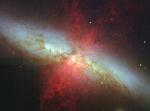 A Superwind from the Cigar Galaxy
4.04.2000
What's lighting up the Cigar Galaxy? M82, as this irregular galaxy is also known, was stirred up by a recent pass near large spiral galaxy M81. This doesn't fully explain the source of the red-glowing outwardly expanding gas, however.
|
January February March April May June July August September October |
|||||||||||||||||||||||||||||||||||||||||||||||||