
|
You entered: surface
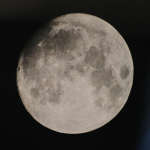 21st Century Wet Collodion Moon
2.01.2021
In the mid 19th century, one of the first photographic technologies used to record the lunar surface was the wet-plate collodion process, notably employed by British astronomer Warren De la Rue. To capture...
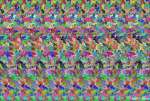 The Holographic Principle and a Teapot
3.10.2021
Sure, you can see the 2D rectangle of colors, but can you see deeper? Counting color patches in the featured image, you might estimate that the most information that this 2D digital image can hold is about 60 (horizontal) x 50(vertical) x 256 (possible colors) = 768,000 bits.
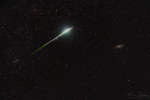 Island Universe, Cosmic Sand
14.08.2021
Stars in our own Milky Way Galaxy are scattered through this eye-catching field of view. From the early hours after midnight on August 13, the 30 second exposure of the night sky over Busko-Zdroj, Poland records the colorful and bright trail of a Perseid meteor.
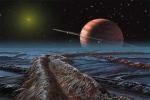 Other Worlds and HD 38529
10.08.2000
After the latest round of discovery announcements, the list of known worlds of distant suns has grown to 50. While extrasolar planet discoveries are sure to continue, none - so far - points clearly to another planetary system like our own. Take, for example, the newly discovered parent star HD38529.
 Sungrazer
26.02.1997
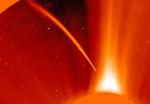
Arcing toward a fiery fate, this Sungrazer comet was recorded by the SOHO spacecraft's Large Angle Spectrometric COronagraph (LASCO) on Dec. 23rd, 1996. LASCO uses an occulting disk, partially visible at the lower...
 Gamma Ray Earth
31.03.2005
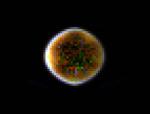
The pixelated planet above is actually our own planet Earth seen in gamma rays - the most energetic form of light. In fact, the gamma rays used to construct this view pack over 35 million electron volts (MeV) compared to a mere two electron volts (eV) for a typical visible light photon.
 Sungrazer
20.05.2000
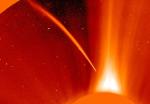
Arcing toward a fiery fate, this Sungrazer comet was recorded by the SOHO spacecraft's Large Angle Spectrometric COronagraph (LASCO) on Dec. 23rd, 1996. LASCO uses an occulting disk, partially visible at the lower...
 Magnetar In The Sky
22.01.2000
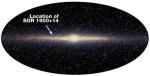
Indicated on this infrared image of the galactic center region is the position of SGR 1900+14 - the strongest known magnet in the galaxy. SGR 1900+14 is believed to be a city-sized, spinning, super-magnetic neutron star, or Magnetar. How strong is a Magnetar's magnetic field?
 A Solar Eclipse from the Moon
7.04.2014
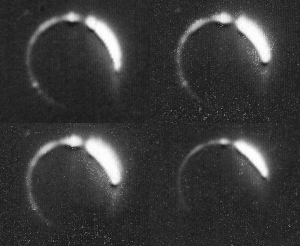
Has a solar eclipse ever been seen from the Moon? Yes, first in 1967 -- but it may happen again next week. The robotic Surveyor 3 mission took thousands of wide angle television images of the Earth in 1967, a few of which captured the Earth moving in front of the Sun.
 Cosmic Collision Forges Galactic Ring
17.09.2018
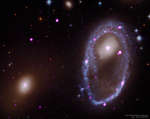
How could a galaxy become shaped like a ring? The rim of the blue galaxy pictured on the right is an immense ring-like structure 150,000 light years in diameter composed of newly formed, extremely bright, massive stars.
|
January February March April May June July August September October |
|||||||||||||||||||||||||||||||||||||||||||||||||