
|
You entered: surface
 APOD: 2025 June 21 Б Two Worlds, Two Analemmas
21.06.2025
Sure, that figure-8 shaped curve you get when you mark the position of the Sun in Earth's sky at the same time each day over one year is called an analemma.
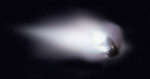 Comet Halleys Nucleus: An Orbiting Iceberg
4.01.2010
What does a comet nucleus look like? Formed from the primordial stuff of the Solar System, comet nuclei were thought to resemble very dirty icebergs. But ground-based telescopes revealed only the surrounding cloud of gas and dust of active comets nearing the Sun, clearly resolving only the comet's coma, and the characteristic cometary tails.
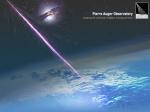 Cosmic Rays from Galactic Centers
12.11.2007
Where do cosmic rays come from? A major step toward answering this century old question may have just come in from the Auger Observatory project, the world's premier cosmic ray observatory. That high energy fundamental particles are barreling through the universe has been known for about a century.
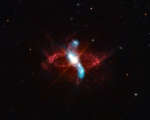 Symbiotic R Aquarii
29.06.2017
A long recognized naked-eye variable star, R Aquarii is actually an interacting binary star system, two stars that seem to have a close, symbiotic relationship. About 710 light years away, it consists of a cool red giant star and hot, dense white dwarf star in mutual orbit around their common center of mass.
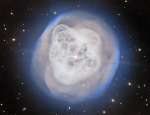 APOD: 2026 May 28 Б NGC 1514: The Crystal Ball Nebula
28.05.2026
What do you see in this crystal ball? The featured image shows NGC 1514, known as the Crystal Ball Nebula, observed by the Gemini North telescope on Maunakea, in Hawai'i. NGC 1514 is 1,500 light-years away and was discovered by William Herschel in 1790.
 Closest Star has Potentially Habitable Planet
25.08.2016
The star closest to the Sun has a planet similar to the Earth. As announced yesterday, recent observations confirmed that this planet not only exists but inhabits a zone where its surface temperature could allow liquid water, a key ingredient for life on Earth.
 An Atlas V Rocket Launches OSIRIS REx
17.10.2016
Have you ever seen a rocket launched into the Solar System? Last month a large Atlas V rocket blasted off from Launch Complex 41 in Florida carrying the ORISIX-REx spacecraft. This robotic spacecraft will attempt to land on Asteroid Bennu and return some of its soil to Earth.
 APOD: 2023 February 1 Б The Seventh World of Trappist 1
1.02.2023
Seven worlds orbit the ultracool dwarf star TRAPPIST-1. A mere 40 light-years away, many of the exoplanets were discovered in 2016 using the Transiting Planets and Planetesimals Small Telescope (TRAPPIST) located in the Atlas Mountains of Morocco, and later confirmed with telescope including NASA's Spitzer Space Telescope.
 Large Sunspot Group AR 9393
11.04.2001
The largest sunspot group of the past ten years crossed the surface of the Sun late last month and early this month. The group was designated Active Region 9393 as it was the 9393rd region identified since counting officially began in 1973.
 Apollo 11: Descent to the Moon
17.07.2019
It had never been done before. But with the words "You're Go for landing", 50 years ago this Saturday, Apollo 11 astronauts Aldrin and Armstrong were cleared to make the first try.
|
January February March April May June July August September October |
|||||||||||||||||||||||||||||||||||||||||||||||||