
|
You entered: surface
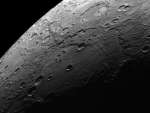 Rembrandt Impact Basin on Mercury
4.05.2009
Why do portions of this huge crater on Mercury have so much iron? The unusual Rembrandt impact basin was discovered recently in images taken during the robotic MESSENGER spacecraft's 2008 October flyby of the Solar System's innermost planet.
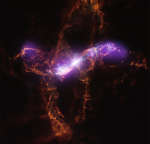 Symbiotic R Aquarii
5.02.2022
Variable star R Aquarii is actually an interacting binary star system, two stars that seem to have a close symbiotic relationship. Centered in this space-based optical/x-ray composite image it lies about 710 light years away.
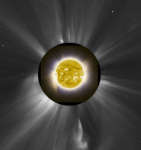 An Active Sun During a Total Eclipse
11.11.2013
Sometimes, a total eclipse of the Sun is an opportunity. Taking advantage of such, the above image shows the solar eclipse earlier this month as covered and uncovered by several different solar observatories.
 Fireball!
26.02.1996
On rare but spectacular occasions, fireballs, meteors brighter than the brightest stars, flash through the heavens - sometimes making audible sounds and occasionally surviving to strike the Earth's surface. The path of one such...
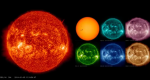 The Sun Rotating
12.03.2014
Does the Sun change as it rotates? Yes, and the changes can vary from subtle to dramatic. In the above time-lapse sequences, our Sun -- as imaged by NASA's Solar Dynamics Observatory -- is shown rotating though the entire month of January.
 APOD: 2020 August 19 Б The Sun Rotating
19.08.2020
Does the Sun change as it rotates? Yes, and the changes can vary from subtle to dramatic. In the featured time-lapse sequences, our Sun -- as imaged by NASA's Solar Dynamics Observatory -- is shown rotating though an entire month in 2014.
 Magnetars In The Sky
26.11.2004
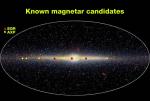
Indicated on this infrared image of the galactic center region are positions of candidate magnetars -- believed to be the strongest magnets in the galaxy. Classified by observers as Soft Gamma Repeaters (SGRs) and Anomalous X-ray Pulsars (AXPs), these cosmic powerhouses are likely city-sized, spinning, highly-magnetized neutron stars. How strong is a magnetar's magnetic field?
 Sungrazer
27.10.2013
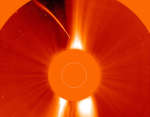
Arcing toward a fiery fate, this Sungrazer comet was recorded by the SOHO spacecraft's Large Angle Spectrometric COronagraph(LASCO) on December 23, 1996. LASCO uses an occulting disk, partially visible at the lower...
 X-Rays From Sirius B
6.10.2000
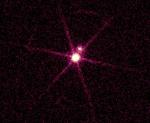
In visible light Sirius A (Alpha Canis Majoris) is the brightest star in the night sky, a closely watched celestial beacon throughout recorded history. Part of a binary star system only 8 light-years away, it was known in modern times to have a small companion star, Sirius B.
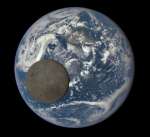 Full Earth, Full Moon
7.08.2015
The Moon was new on July 16. Its familiar nearside facing the surface of planet Earth was in shadow. But on that date a million miles away, the Deep Space Climate Observatory (DSCOVR) spacecraft's Earth Polychromatic Imaging Camera (EPIC) captured this view of an apparently Full Moon crossing in front of a Full Earth.
|
January February March April May June July August September October |
|||||||||||||||||||||||||||||||||||||||||||||||||