
|
You entered: time
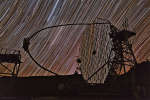 MAGIC Star Trails
14.10.2011
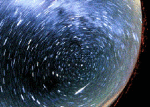
Colorful star trails arc across the night in this surreal timelapse skyscape from the Roque de los Muchachos Observatory on the Canary island of La Palma. A reflection of the Earth's daily rotation on its axis, the star trails are also reflected in one of a pair of 17 meter diameter, multi-mirrored MAGIC telescopes.
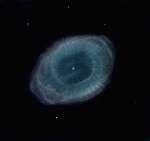 Ring Nebula Drawn
15.09.2012
A planetary nebula with a simple symmetry familiar to telescopic sky gazers, the Ring Nebula (M57) is some 2,000 light-years away in the musical constellation Lyra. Hints of changing colors and subtle details are brought out in this remarkable sketch of the cosmic ring.
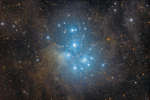 M45: The Pleiades Star Cluster
18.09.2013
Have you ever seen the Pleiades star cluster? Even if you have, you probably have never seen it as dusty as this. Perhaps the most famous star cluster on the sky, the bright stars of the Pleiades can be seen without binoculars from even the depths of a light-polluted city.
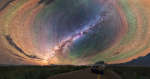 Colorful Airglow Bands Surround Milky Way
6.03.2018
Why would the sky glow like a giant repeating rainbow? Airglow. Now air glows all of the time, but it is usually hard to see. A disturbance however -- like an approaching storm -- may cause noticeable rippling in the Earth's atmosphere.
 Live: Cosmic Rays from Minnesota
6.08.2018
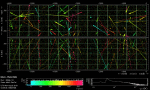
Cosmic rays from outer space go through your body every second. Typically, they do you no harm. The featured image shows some of these fast moving particles as streaks going through Fermilab's NOvA Far Detector located in Ash River, Minnesota, USA.
 APOD: 2025 August 25 Б The Meteor and the Star Cluster
25.08.2025
Sometimes even the sky surprises you. To see more stars and faint nebulosity in the Pleiades star cluster (M45), long exposures are made. Many times, less interesting items appear on the exposures that were not intended -- but later edited out.
 A Step Toward Gravitational Wave Detection
30.10.2000
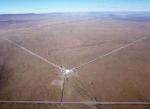
Accelerate a charge and you'll get electromagnetic radiation: light. But accelerate any mass and you'll get gravitational radiation. Light is seen all the time, but, so far, a confirmed direct detection of gravitational radiation has yet to be made.
 Crater On Ice
14.07.2000
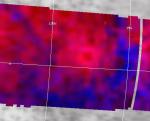
Impact craters are common on Earth's moon but on Jupiter's large ice moon Europa, they are very rare. Over time, both bodies have been subjected to an intense pounding by the solar system's formative debris, but geological activity on Europa's surface seems to have erased most of these impact scars.
 Galactic Center Flicker Indicates Black Hole
10.09.2001
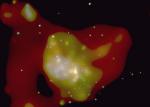
Why would the center of our Galaxy flicker? Many astronomers believe the only credible answer involves a black hole. During observations of Sagittarius A* with the orbiting Chandra X-ray Observatory, the bright X-ray source at the very center of our Milky Way brightened dramatically for a few minutes.
 Orionids Meteor Shower to Peak Tonight
21.10.1996
Tonight you might be able to see Halley's Comet again - or at least some pieces of it. It is widely thought that that the meteors from the Orionids meteor shower, which peaks tonight, are just small pieces of Halley's Comet falling to Earth.
|
January February March April May June July August |
||||||||||||||||||||||||||||||||||||||||||||||||||||||||