
|
You entered: time
 Zodiacal Light and the False Dawn
12.09.2001
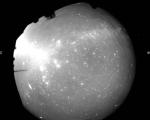
An unusual triangle of light will be particularly bright near the eastern horizon before sunrise during the next two months for observers in Earth's northern hemisphere. Once considered a false dawn, this triangle of light is actually Zodiacal Light, light reflected from interplanetary dust particles.
 The Center of Centaurus A
21.04.2002
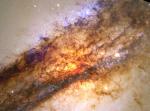
A fantastic jumble of young blue star clusters, gigantic glowing gas clouds, and imposing dark dust lanes surrounds the central region of the active galaxy Centaurus A. This mosaic of Hubble Space Telescope images taken in blue, green, and red light has been processed to present a natural color picture of this cosmic maelstrom.
 Comet Hyakutake and a Cactus
1.05.1996
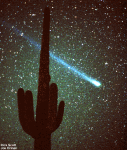
Comet Hyakutake is shown photographed the night of March 27 in Arizona, USA, with a cactus in the foreground. Polaris, the north star, is the bright star seen just to the upper right of the comet's head. Today Comet Hyakutake reaches its closest approach to the Sun.
 Aurora in Colorado Skies
30.10.2003
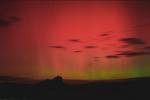
Vivid auroral displays were triggered by a cloud of high energy particles from the Sun that collided with planet Earth's magnetosphere yesterday, October 29, at about 06:30 Universal Time. The collision...
 Unusual Spherules on Mars
10.02.2004
What are those unusual spherules on Mars? The Mars Opportunity rover has now photographed several unusual nodules on Mars that have a nearly spherical shape. Many times these spherules are embedded in larger rock outcroppings but appear grayer.
 Venus and the Pleiades
15.04.2004
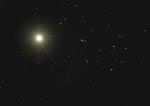
Venus still rules the western skies after sunset as the brilliant evening star. While wandering the ecliptic with its fellow naked-eye planets earlier this month, it passed near the Pleiades star cluster, providing a striking photo opportunity for earthbound skygazers.
 Animation of Asteroids Passing Near Earth
28.03.2006
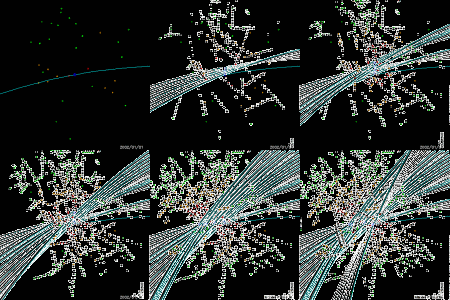
How often does an asteroid whiz by the Earth? The above time-lapse animation follows the orbit of the Earth around the Sun for two months in 2002 as numerous asteroids, also known as minor planets, approach and pass by. Some asteroids appear out of nowhere as they are plotted only when they were discovered.
 Comet Hartley 2 Flyby
5.11.2010
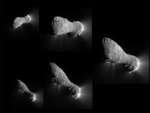
Follow these 5 frames clockwise starting from the top left to track the view from the EPOXI mission spacecraft as it approached, passed under, and then looked back at the nucleus of comet Hartley 2 on November 4. Its closest approach distance was about 700 kilometers.
 Ring of Fire over Monument Valley
9.05.2013
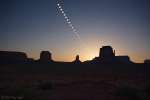
As the New Moon continues this season's celestial shadow play, an annular solar eclipse track begins in western Australia at 22:30 UT on May 9 -- near sunrise on May 10 local time.
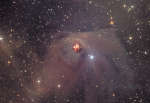 T Tauri and Hind s Variable Nebula
3.05.2014
The yellowish star near center in this dusty telescopic skyview is T Tauri, prototype of the class of T Tauri variable stars. Just next door is the yellow cosmic cloud historically known as Hind's Variable Nebula (NGC 1555).
|
January February March April May June July August |
||||||||||||||||||||||||||||||||||||||||||||||||||||||||