
|
You entered: clouds
 Moonrays of August
4.08.2023
A Full Moon rose as the Sun set on August 1. Near perigee, the closest point in its almost moonthly orbit, the brighter than average lunar disk illuminated night skies around planet Earth as the second supermoon of 2023.
 APOD: 2025 September 5 Б 47 Tucanae: Globular Star Cluster
5.09.2025
Also known as NGC 104, 47 Tucanae is a jewel of the southern sky. Not a star but a dense cluster of stars, it roams the halo of our Milky Way Galaxy along with some 200 other globular star clusters.
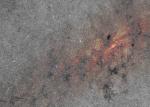 The Galactic Center in Infrared
8.07.2001
The center of our Galaxy is a busy place. In visible light, much of the Galactic Center is obscured by opaque dust. In infrared light, however, dust glows more and obscures less, allowing nearly one million stars to be recorded in the above photograph.
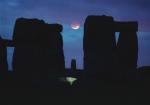 Moon Between the Stones
25.05.2004
Despite clouds and rain showers astronomer Phillip Perkins managed to spot a reddened, eclipsed Moon between the stones of this well known monument to Sun during May's total lunar eclipse, from Stonehenge, England.
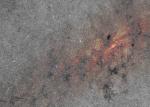 The Galactic Center in Infrared
7.11.2004
The center of our Galaxy is a busy place. In visible light, much of the Galactic Center is obscured by opaque dust. In infrared light, however, dust glows more and obscures less, allowing nearly one million stars to be recorded in the above photograph.
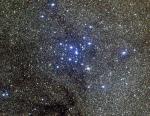 The M7 Open Star Cluster in Scorpius
5.04.2000
M7 is one of the most prominent open clusters of stars on the sky. The cluster, dominated by bright blue stars, can be seen with the naked eye in a dark sky in the tail of the constellation of Scorpius.
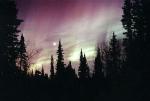 Aurora Through a Moonlit Sky
2.11.1999
A night sky can glow in fascinating ways. Through a clearing in the woods, the pictured sky above Alaska shines by reflected light from a nearby city, by the brightness of the Moon, and by aurora.
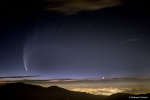 Comet McNaught Over Chile
20.01.2008
Comet McNaught was perhaps the most photogenic comet of our time. After making quite a show in the northern hemisphere in early January, the comet moved south and developed a long and unusual dust tail that dazzled southern hemisphere observers. In this image, Comet McNaught was captured one year ago above Chile.
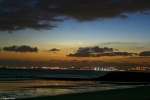 June s Young Crescent Moon
7.06.2008
Serene skyviews were enjoyed across planet Earth earlier this week with a young crescent Moon low in the western sky just after sunset. Recorded on June 4, this colorful example includes a quiet beach in the foreground with the city lights of Lisbon, Portugal, and the Sintra Mountains along the horizon.
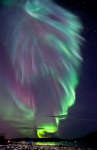 Aurora Over Norway
20.09.2010
Auroras can make spectacular sights. Photographed above last weekend, flowing multi-colored auroras helped illuminate a busy sky above TromsЬ, Norway. Besides the spectacular aurora pictured above, the photographer caught three satellites streaks, one airplane streak, and a friend trying to capture the same sight.
|
January February March April May June July August September October |
|||||||||||||||||||||||||||||||||||||||||||||||||