
|
You entered: clouds
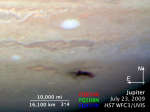 Hubble View: Jupiter Impact
31.07.2009
This sprawling dark marking is Jupiter's latest impact scar, a debris plume created as a small asteroid or comet disintegrated after plunging into the gas giant's atmosphere. Located in Jupiter's south polar region, the new feature was discovered by Australian amateur astronomer Anthony Wesley on July 19.
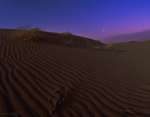 Brighter Than Mars
27.08.2010
Even though you may have just read an email claiming Mars will be incredibly bright tonight, the brightest star on the horizon is not Mars. From central Iran on August 24th, the brightest star in this twilight desert skyview is Venus, aka the Evening Star.
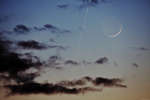 Jupiter and the Moons of Earth
27.04.2012
Planet Earth has many moons. Its largest artifical moon, the International Space Station, streaks through this lovely skyview with clouds in silhouette against the fading light of a sunset. Captured from Stuttgart, Germany last Sunday, the frame also includes Earth's largest natural satellite 1.5 days after its New Moon phase.
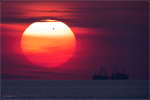 A Venus Transit Over the Baltic Sea
13.06.2012
Waiting years and traveling kilometers -- all to get a shot like this. And even with all of this planning, a good bit of luck was helpful. As the Sun rose over the Baltic...
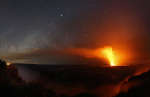 Jupiter Season, Hawaiian Sky
2.06.2018
Volcanic activity on the Big Island of Hawaii has increased since this Hawaiian night skyscape was recorded earlier this year. Recent vents and lava flows are about 30 kilometers to the east, the direction...
 The Elephant s Trunk in Cepheus
21.11.2024
Like an illustration in a galactic Just So Story, the Elephant's Trunk Nebula winds through the emission region and young star cluster complex IC 1396, in the high and far off constellation of Cepheus. Also known as vdB 142, this cosmic elephant's trunk is over 20 light-years long.
 APOD: 2025 January 21 Б Comet ATLAS over Brasilia
21.01.2025
What's that in the sky? Above the city, above most clouds, far in the distance: it's a comet. Pictured, the impressive tail of Comet C/2024 G3 (ATLAS) was imaged from Brasцlia, Brazil four days ago.
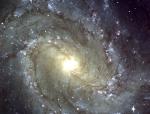 M83: The Southern Pinwheel Galaxy from VLT
6.12.1999
M83 is one of the closest and brightest spiral galaxies on the sky. Visible with binoculars in the constellation of Hydra, majestic spiral arms have prompted its nickname as the Southern Pinwheel. Although discovered...
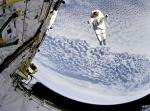 A Flying Astronaut Over Earth
2.10.2001
What would it be like to fly free over the seas and clouds of Earth? In 1994 astronaut Mark Lee found out when he tested the Simplified Aid for EVA Rescue (SAFER) system for NASA. SAFER is a backpack propulsion unit that incorporates small nitrogen thrusters controlled by hand and moderated by computer.
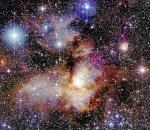 Star-Forming Region RCW38 from 2MASS
17.07.2002
The star cluster in RCW38 was hiding. Looking at the star forming region RCW38 will not normally reveal most of the stars in this cluster. The reason is that the open cluster is so young that it is still shrouded in thick dust that absorbs visible light.
|
January February March April May June July August September October |
|||||||||||||||||||||||||||||||||||||||||||||||||