
|
You entered: clouds
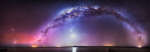 From the Northern to the Southern Cross
27.01.2019
There is a road that connects the Northern to the Southern Cross but you have to be at the right place and time to see it. The road, as pictured here, is actually...
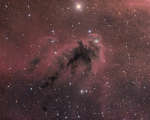 LDN 1622: Dark Nebula in Orion
2.02.2019
The silhouette of an intriguing dark nebula inhabits this cosmic scene. Lynds' Dark Nebula (LDN) 1622 appears against a faint background of glowing hydrogen gas only easily seen in long telescopic exposures of the region.
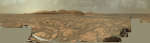 Curiosity: Sol 3048
25.03.2021
Before Perseverance there was Curiosity. In fact, the Curiosity rover accomplished the first sky crane maneuver touchdown on Mars on April 5, 2012. March 2, 2021 marked Curiosity's 3,048th martian day operating on the surface of the Red Planet.
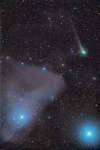 Stardust and Comet Tails
20.08.2022
Heading for its closest approach to the Sun, or perihelion, on December 19 comet C/2017 K2 (PanSTARRS) remains a sight for telescopic observers as it sweeps through planet Earth's skies in the constellation Scorpius.
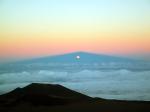 Moonrise Through Mauna Keas Shadow
3.12.2003
How can the Moon rise through a mountain? It cannot -- what was photographed here is a moonrise through the shadow of a large volcano. The volcano is Mauna Kea, Hawai'i, USA, a frequent spot for spectacular photographs since it is arguably the premier observing location on planet Earth.
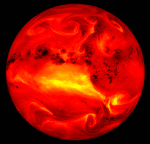 The Water Vapor Channel
4.09.1999
What alien planet's bizarre landscape lurks below these fiery-looking clouds? It's only Planet Earth, of course ... as seen on the Water Vapor Channel. Hourly, images like this one (an infrared image shown in false color) are brought to you by the orbiting Geostationary Operational Environmental Satellites' (GOES) multi-channel imagers.
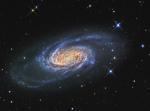 Bright Galaxy NGC 2903
6.07.2007
Spiral galaxy NGC 2903 is only some 20 million light-years distant in the constellation Leo. One of the brighter galaxies visible from the northern hemisphere, it is surprisingly missing from Charles Messier's famous catalog of celestial sights. This impressively sharp color image shows off the galaxy's beautiful blue spiral arms.
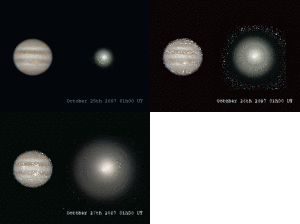 Comet Holmes Coma Expands
30.10.2007
Go outside tonight and see Comet Holmes. No binoculars or telescopes are needed -- just curiosity and a sky map. Last week, Comet 17P/Holmes underwent an unusual outburst that vaulted it unexpectedly from obscurity into one of the brightest comets in recent years.
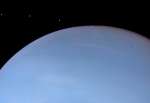 Despina, Moon of Neptune
3.09.2009
Despina is a tiny moon of Neptune. A mere 148 kilometers across, diminutive Despina was discovered in 1989, in images from the Voyager 2 spacecraft taken during its encounter with the solar system's most distant gas giant planet.
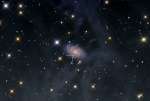 Art and Science in NGC 981
12.11.2009
This beautiful telescopic skyscape features spiral galaxy NGC 981. The island universe is about 50,000 light-years across and lies some 60 million light-years away toward the constellation Aries. An artistic presentation, the image...
|
January February March April May June July August September October |
|||||||||||||||||||||||||||||||||||||||||||||||||