
|
You entered: clouds
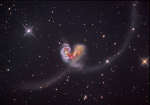 The Antennae
7.05.2010
Some 60 million light-years away in the southerly constellation Corvus, two large galaxies collided. But the stars in the two galaxies cataloged as NGC 4038 and NGC 4039 don't collide in the course of the ponderous, billion year or so long event.
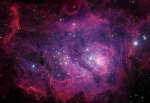 The Wide and Deep Lagoon
9.09.2016
Ridges of glowing interstellar gas and dark dust clouds inhabit the turbulent, cosmic depths of the Lagoon Nebula. Also known as M8, the bright star forming region is about 5,000 light-years distant.
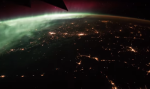 Flying over the Earth at Night II
12.03.2018
What would it be like to orbit the Earth? The International Space Station (ISS) does this every 90 minutes, and sometimes the astronauts on board take image sequences that are made into videos. The featured time-lapse video shows many visual spectacles of the dark Earth below.
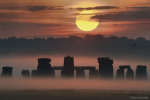 Sunrise Solstice over Stonehenge
20.06.2021
Today the Sun reaches its northernmost point in planet Earth's sky. Called a solstice, many cultures mark this date as a change of seasons -- from spring to summer in Earth's Northern Hemisphere and from fall to winter in Earth's Southern Hemisphere.
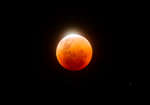 A Jewel on the Flower Moon
18.05.2022
Cloudy skies plagued some sky watchers on Sunday as May's Full Flower Moon slipped through Earth's shadow in a total lunar eclipse. In skies above Chile's Atacama desert this telephoto snapshot still captured an awesome spectacle though.
 NGC 604: Giant Stellar Nursery
25.04.2024
Located some 3 million light-years away in the arms of nearby spiral galaxy M33, giant stellar nursery NGC 604 is about 1,300 light-years across. That's nearly 100 times the size of the Milky Way's Orion Nebula, the closest large star forming region to planet Earth.
 The View from Everest
6.03.2005
What would it be like to stand atop the tallest mountain on Earth? To see a full panoramic vista from there, scroll right. Visible are snow peaked mountains near and far, tremendous cliffs, distant plateaus, the tops of clouds, and a dark blue sky. Mt.
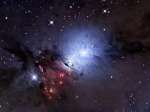 NGC 1333 Stardust
18.04.2009
NGC 1333 is seen in visible light as a reflection nebula, dominated by bluish hues characteristic of starlight reflected by dust. A mere 1,000 light-years distant toward the heroic constellation Perseus, it lies at the edge of a large, star-forming molecular cloud.
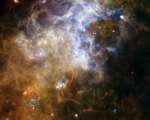 Herschel Views the Milky Way
16.10.2009
With a 3.5 meter diameter mirror, larger than the Hubble Space Telescope, Herschel is ESA's new infrared observatory. The space-based telescope is named for German-born British astronomer Frederick William Herschel who discovered infrared light over 200 years ago.
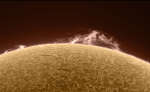 Reinvigorated Sun and Prominence
23.03.2010
Dramatic prominences can sometimes be seen looming just beyond the edge of the sun. Such was the case last week as a giant prominence, visible above on the right, highlighted a Sun showing increased activity as it comes off an unusually quiet Solar Minimum.
|
January February March April May June July August September October |
|||||||||||||||||||||||||||||||||||||||||||||||||