
|
You entered: clouds
 APOD: 2023 July 16 Б Meteor and Milky Way over the Alps
16.07.2023
Now this was a view with a thrill. From Mount Tschirgant in the Alps, you can see not only nearby towns and distant Tyrolean peaks, but also, weather permitting, stars, nebulas, and the band of the Milky Way Galaxy.
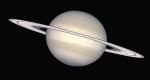 Natural Saturn On The Cassini Cruise
5.11.1998
What you could see approaching Saturn aboard an interplanetary cruise ship would closely resemble this subtly shaded view of the gorgeous ringed gas giant. Processed by the Hubble Heritage project, the picture intentionally avoids...
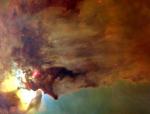 In the Center of the Lagoon Nebula
4.03.2003
The center of the Lagoon Nebula is busy with the awesome spectacle of star formation. Visible in the lower left, at least two long funnel-shaped clouds, each roughly half a light-year long, have been formed by extreme stellar winds and intense energetic starlight. The tremendously bright nearby star, Hershel 36, lights the area.
 A Panorama from Mauna Kea
4.07.2005
Typically, views from Mauna Kea are up and dark. That's because the famous dormant volcano in Hawaii is arguably Earth's premier observing platform of the complex and ever changing night sky. However, this daytime view is across and bright. White snow and white clouds seem to blend together to make an alien landscape.
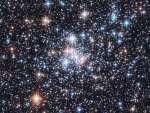 Open Cluster NGC 290: A Stellar Jewel Box
3.08.2008
Jewels don't shine this bright -- only stars do. Like gems in a jewel box, though, the stars of open cluster NGC 290 glitter in a beautiful display of brightness and color. The photogenic cluster, pictured above, was captured recently by the orbiting Hubble Space Telescope.
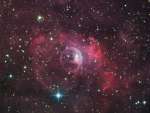 The Bubble Nebula
24.01.2009
Blown by the wind from a massive star, this interstellar apparition has a surprisingly familiar shape. Cataloged as NGC 7635, it is also known simply as The Bubble Nebula. This colorful telescopic image includes a long exposure through a hydrogen alpha filter to reveal details of the cosmic bubble and its environment.
 IC 1805: The Heart Nebula
14.02.2009
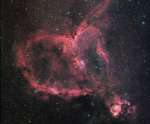
Sprawling across almost 200 light-years, emission nebula IC 1805 is a mix of glowing interstellar gas and dark dust clouds. Derived from its Valentine's-Day-approved shape, its nickname is the Heart Nebula. About 7,500 light-years away in the Perseus spiral arm of our galaxy, stars were born in IC 1805.
 A Double Eclipse of the Sun
21.03.2015
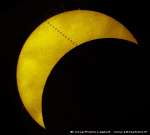
Can the Sun be eclipsed twice at the same time? Last Friday was noteworthy because part of the Earth was treated to a rare total eclipse of the Sun. But also on Friday, from...
 Globular Star Cluster 47 Tuc
8.02.2024
Globular star cluster 47 Tucanae is a jewel of the southern sky. Also known as NGC 104, it roams the halo of our Milky Way Galaxy along with some 200 other globular star clusters. The second brightest globular cluster (after Omega Centauri) as seen from planet Earth, 47 Tuc lies about 13,000 light-years away.
 The UV SMC from UIT
24.03.2001
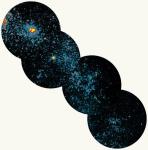
Translated from the "acronese" the title reads - The UltraViolet Small Magellanic Cloud from the Ultraviolet Imaging Telescope. FYI, the four ultraviolet images used in this mosaic of the nearby irregular galaxy known...
|
January February March April May June July August September October |
|||||||||||||||||||||||||||||||||||||||||||||||||