
|
You entered: Earth
 The Local Fluff
24.09.2013
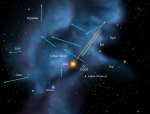
The stars are not alone. In the disk of our Milky Way Galaxy about 10 percent of visible matter is in the form of gas, called the interstellar medium (ISM). The ISM is not uniform, and shows patchiness even near our Sun.
 The Rise and Fall of Supernova 2015F
9.02.2016
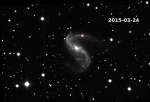
Sit back and watch a star explode. The actual supernova occurred back when dinosaurs roamed the Earth, but images of the spectacular event began arriving last year. Supernova 2015F was discovered in nearby spiral...
 Solar Granules at Record High Resolution
3.02.2020
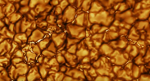
Why does the Sun's surface keep changing? The help find out, the US National Science Foundation (NSF) has built the Daniel K. Inouye Solar Telescope in Hawaii, USA. The Inouye telescope...
 Starlink over Orion
1.06.2021
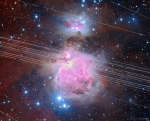
What are those streaks across Orion? Most are reflections of sunlight from numerous Earth-orbiting Starlink satellites. Appearing by eye as a series of successive points floating across a twilight sky, the increasing number of SpaceX Starlink communication satellites are causing concern among many astronomers.
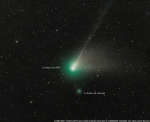 ZTF meets ATLAS
10.02.2023
Fading as it races across planet Earth's northern skies comet C/2022 E3 (ZTF) shares this telescopic frame with comet C/2022 U2 (ATLAS). Captured on the night of February 6 from a garden observatory in Germany's Bavarian Forest, the starry field of view toward the constellation Auriga spans about 2.5 degrees.
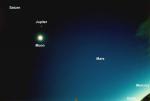 Sky and Planets
10.03.2000
On February 10th, an evocative evening sky above Rocklin, California, USA inspired astrophotographer Steve Sumner to record this remarkable sight - five planets and the Moon. Near its first quarter phase, the bright Moon...
 A Sudden Jet on Comet 67P?
18.11.2015
There she blows! A dramatic demonstration of how short-lived some comet jets can be was documented in late July by the robotic Rosetta spacecraft orbiting the nucleus of Comet 67P/Churyumov-Gerasimenko. The featured animation depicts changes in the rotating comet with three illuminating stills.
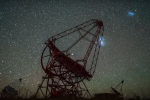 HESS Telescopes Explore the High Energy Sky
8.01.2019
They may look like modern mechanical dinosaurs but they are enormous swiveling eyes that watch the sky. The High Energy Stereoscopic System (H.E.S.S.) Observatory is composed of four 12-meter reflecting-mirror telescopes surrounding a larger telescope housing a 28-meter mirror.
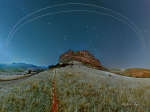 Spacecrafts Streak Over Colorado
14.03.2011
Have you ever seen a "star" drifting slowly overhead, but not known what it was? Sometimes even pointing it out to friends or family will only lead to a shrug. What you are seeing...
 APOD: 2023 September 6 Б HESS Telescopes Explore the High Energy Sky
6.09.2023
They may look like modern mechanical dinosaurs, but they are enormous swiveling eyes that watch the sky. The High Energy Stereoscopic System (H.E.S.S.) Observatory is composed of four 12-meter reflecting-mirror telescopes surrounding a larger telescope housing a 28-meter mirror.
|
January February March April May June July August September October |
|||||||||||||||||||||||||||||||||||||||||||||||||