
|
You entered: Earth
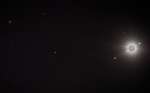 Two Planet Opposition
8.10.2010
In late September, two planets were opposite the Sun in Earth's sky, Jupiter and Uranus. Consequently closest to Earth, at a distance of only 33 light-minutes and 2.65 light-hours respectively, both were good targets for telescopic observers.
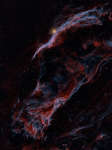 Along the Western Veil
19.09.2019
Delicate in appearance, these filaments of shocked, glowing gas, are draped across planet Earth's sky toward the constellation of Cygnus. They form the western part of the Veil Nebula. The Veil Nebula itself is a large supernova remnant, an expanding cloud born of the death explosion of a massive star.
 Temperatures on Exoplanet WASP 43b
3.05.2024
A mere 280 light-years from Earth, tidally locked, Jupiter-sized exoplanet WASP-43b orbits its parent star once every 0.8 Earth days. That puts it about 2 million kilometers (less than 1/25th the orbital distance of Mercury) from a small, cool sun.
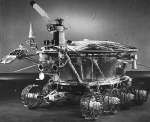 Lunokhod: Reflections on a Moon Robot
6.06.2010
It may look like some sort of cute alien robot, but it was created here on Earth, launched to the Moon in 1970, and now reflects laser light in a scientifically useful way. On November 17, 1970 the Soviet Luna 17 spacecraft landed the first roving remote-controlled robot on the Moon.
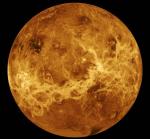 Venus Unveiled
3.09.2005
The surface of Venus is perpetually covered by a veil of thick clouds and remains hidden from even the powerful telescopic eyes of earth-bound astronomers. But in the early 1990s, using imaging radar...
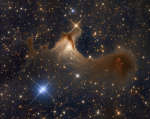 Ghost of the Cepheus Flare
30.10.2010
Spooky shapes seem to haunt this starry expanse, drifting through the night in the royal constellation Cepheus. Of course, the shapes are cosmic dust clouds faintly visible in dimly reflected starlight. Far from your...
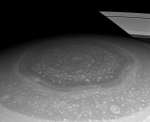 Saturns Hexagon and Rings
20.02.2013
Why would clouds form a hexagon on Saturn? Nobody is sure. Originally discovered during the Voyager flybys of Saturn in the 1980s, nobody has ever seen anything like it anywhere else in the Solar System.
 Fomalhaut's Dusty Debris Disk
11.05.2023
Fomalhaut is a bright star, a 25 light-year voyage from planet Earth in the direction of the constellation Piscis Austrinus. Astronomers first noticed Fomalhaut's excess infrared emission in the 1980s. Space and ground-based...
 APOD: 2023 November 19 Б Space Station, Solar Prominences, Sun
19.11.2023
That's no sunspot. It's the International Space Station (ISS) caught passing in front of the Sun. Sunspots, individually, have a dark central umbra, a lighter surrounding penumbra, and no Dragon capsules attached.
 Phaethon s Brood
12.12.2024
Based on its well-measured orbit, 3200 Phaethon (sounds like FAY-eh-thon) is recognized as the source of the meteoroid stream responsible for the annual Geminid meteor shower. Even though most meteor shower parents are comets, 3200 Phaethon is a known and closely tracked near-Earth asteroid with a 1.4 year orbital period.
|
January February March April May June July August September October |
|||||||||||||||||||||||||||||||||||||||||||||||||