
|
You entered: Earth
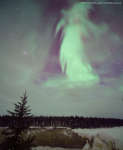 Ghost Aurora over Canada
27.10.2019
What does this aurora look like to you? While braving the cold to watch the skies above northern Canada early one morning in 2013, a most unusual aurora appeared. The aurora definitely appeared to be shaped like something , but what?
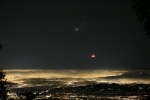 A Happy Sky Over Los Angeles
3.12.2008
Sunday, the sky seemed to smile over much of planet Earth. Visible the world over was an unusual superposition of our Moon and the planets Venus and Jupiter. Pictures taken at the right time...
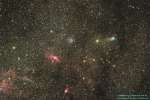 Comet Lemmon and the Deep Sky
20.07.2013
Now sweeping high above the ecliptic plane, Comet Lemmon has faded dramatically in planet Earth's night sky as it heads for the outer solar system. Some 16 light-minutes (2 AU) from...
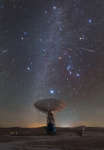 Geminids of the North
15.12.2017
Earth's annual Geminid meteor shower did not disappoint as our fair planet plowed through dust from active asteroid 3200 Phaethon. Captured in this northern hemisphere nightscape, the meteors stream away from the shower's radiant in Gemini.
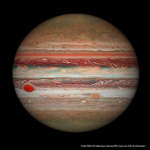 Hubbles Jupiter and the Shrinking Great Red Spot
9.01.2022
What will become of Jupiter's Great Red Spot? Gas giant Jupiter is the solar system's largest world with about 320 times the mass of planet Earth. Jupiter is home to one of the largest and longest lasting storm systems known, the Great Red Spot (GRS), visible to the left.
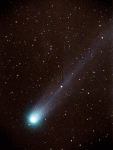 What are Comet Tails Made Of?
26.03.1996
The tail of comet Hyakutake, visible in this recent color image, is composed of dust and gas driven off the icy comet nucleus by the Sun's heat and blown away by the solar wind. Bathed in solar ultraviolet light, the gas molecules break down and are excited, producing a characteristic glow.
 GRB 221009A
15.10.2022
Gamma-ray burst GRB 221009A likely signals the birth of a new black hole, formed at the core of a collapsing star long ago in the distant universe. The extremely powerful blast is depicted in this animated gif constructed using data from the Fermi Gamma Ray Space Telescope.
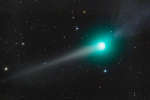 Two Tails of Comet Lulin
25.02.2009
Go outside tonight and see Comet Lulin. From a dark location, you should need only a good star map and admirable perseverance -- although wide-field binoculars might help. Yesterday, Comet Lulin passed its closest to Earth, so that the comet will remain near its brightest over the next few days.
 Night Shinings
2.07.2008
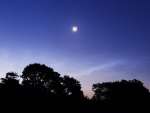
In the early morning hours of June 30th, ghostly clouds hovered in the east in this view of near dawn skies over western France. The noctilucent or night-shining clouds lie near the edge of space, reflecting sunlight from about 80 kilometers above Earth's surface.
 Reflections of the Ghost Nebula
26.10.2020
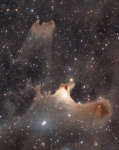
Do any shapes seem to jump out at you from this interstellar field of stars and dust? The jeweled expanse, filled with faint, starlight-reflecting clouds, drifts through the night in the royal constellation of Cepheus.
|
January February March April May June July August September October |
|||||||||||||||||||||||||||||||||||||||||||||||||