
|
You entered: Earth
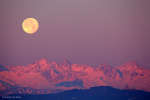 Alpine Superga Moonset
8.12.2017
December's Full Moon phase occurred near perigee, the closest point in its orbit around our fair planet. Big and bright, the fully illuminated lunar disk sets over rugged mountains in this early morningscape from Turin, Italy.
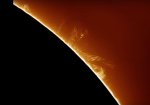 An Active Prominence on the Sun
18.06.2018
Sometimes the Sun's surface becomes a whirlwind of activity. Pictured is a time-lapse video of the Sun's surface taken over a two hour period in early May, run both forwards and backwards. The Sun's surface was blocked out so that details over the edge could be imaged in greater detail.
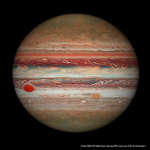 Hubbles Jupiter and the Shrinking Great Red Spot
25.04.2018
What will become of Jupiter's Great Red Spot? Gas giant Jupiter is the solar system's largest world with about 320 times the mass of planet Earth. Jupiter is home to one of the largest and longest lasting storm systems known, the Great Red Spot (GRS), visible to the left.
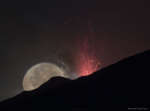 Moon behind Lava Fountain
4.09.2018
What's happened to the Moon? Nothing, but something has happened to the image of the Moon. The heat from a volcanic lava fountain in the foreground has warmed and made turbulent the air nearby, causing passing light to refract differently than usual.
 A Charioteer s Comet
1.03.2019
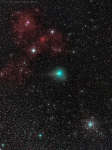
Still racing across planet Earth's night skies, Comet Iwamoto (C/2018 Y1) shares this pretty telescopic field of view with stars and nebulae of northern constellation Auriga, the Charioteer. Captured on February 27, Iwamoto's greenish coma and faint tail appear between a complex of reddish emission nebulae and open star cluster M36 (bottom right).
 Equinox: The Sun from Solstice to Solstice
23.09.2019
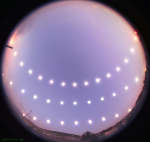
Today is an equinox, a date when day and night are equal. Tomorrow, and every day until the next equinox, the night will be longer than the day in Earth's northern hemisphere, and the day will be longer than the night in Earth's southern hemisphere.
 Earths Major Telescopes Investigate GRB 130427A
8.05.2013
A tremendous explosion has occurred in the nearby universe and major telescopes across Earth and space are investigating. Dubbed GRB 130427A, the gamma-ray burst was first seen by the Earth-orbiting Swift satellite in high energy X-rays and quickly reported down to Earth.
 On The Trail Of A Fireball
19.02.1999
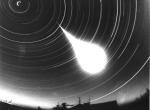
This exceptionally bright fireball meteor trail was photographed with a fish-eye camera at a Czech Republic station of the European Fireball Network on January 21, 1999. Of the star trails visible in this night-long exposure, the bright short arc in the upper left is due to Polaris, the north star.
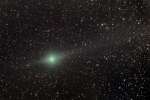 Comet Lulin Approaches
2.02.2009
How bright will Comet Lulin become? No one knows for sure. Although it is notoriously difficult to accurately predict the brightness of newly discovered comets, Comet Lulin could well become visible to the unaided eye later this month.
 APOD: 2024 February 12 Б HFG1 & Abell 6: Planetary Nebulae
12.02.2024
Planetary nebulae like Heckathorn-Fesen-Gull 1 (HFG1) and Abell 6 in the constellation Cassiopeia are remnants from the last phase of a medium sized star like our Sun. In spite of their shapes, planetary nebulae have nothing in common with actual planets.
|
January February March April May June July August September October |
|||||||||||||||||||||||||||||||||||||||||||||||||