
|
You entered: Earth
 APOD: 2026 August 5 Б Spokes on Saturn's B Ring
5.08.2026
DonБt get spooked by SaturnБs ghostly spokes! Today we feature a nearly two-hour timelapse of Saturn and its rings looping forwards and backwards. A day on Saturn is only 10 hours long, so two hours of observation covers quite a bit of its rotation.
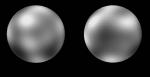 Hubble Telescope Maps Pluto
11.03.1996
No spacecraft from Earth has yet explored Pluto but astronomers have found ways of mapping its surface. A stunning map of this distant, diminutive planet, the first based on direct images, was revealed late last week in a Hubble Space Telescope press release.
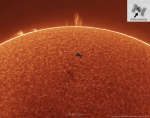 Space Station, Solar Prominences, Sun
4.05.2021
That's no sunspot. It's the International Space Station (ISS) caught passing in front of the Sun. Sunspots, individually, have a dark central umbra, a lighter surrounding penumbra, and no Dragon capsules attached.
 Vega and Comet 12P Pons-Brooks
8.12.2023
On December 4, periodic Comet 12P/Pons-Brooks shared this telescopic field of view with Vega, alpha star of the northern constellation Lyra. Fifth brightest star in planet Earth's night, Vega is some 25 light-years distant while the much fainter comet was about 21 light-minutes away.
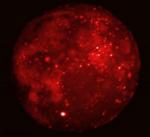 Eclipsed Moon in Infrared
8.11.2003
The total lunar eclipse of September 1996 disappointed many observers in North America who were cursed with cloudy skies. However, the Midcourse Space Experiment (MSX) satellite had a spectacular view from Earth orbit and SPIRIT III, an on board infrared telescope, was used to repeatedly image the moon during the eclipse.
 The Crew 8 Nebula
7.03.2024
Not the James Webb Space Telescope's latest view of a distant galactic nebula, this cloud of gas and dust dazzled spacecoast skygazers on March 3. The telephoto snapshot was taken minutes after the launch of a Falcon 9 rocket on the SpaceX Crew-8 mission, to the International Space Station.
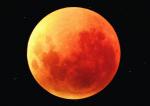 Lingering Lunar Eclipse
26.07.2000
As the Moon passed almost directly through the center of Earth's shadow on July 16th, sky gazers in the Pacific hemisphere were graced by a lingering lunar eclipse. The total phase lasted 1 hour and 47 minutes, the longest since 1859. A longer total lunar eclipse won't occur until the year 3000.
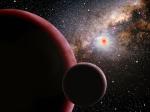 Super Earths May Circle Other Stars
20.03.2006
Are "super-Earths" common around other star systems? Quite possibly. Unexpected evidence for this came to light recently when a planet orbiting a distant star gravitationally magnified the light of an even more distant star.
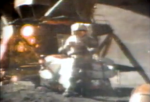 Hammer Versus Feather on the Moon
1.11.2011
If you drop a hammer and a feather together, which reaches the ground first? On the Earth, it's the hammer, but is the reason only because of air resistance? Scientists even before Galileo have pondered and tested this simple experiment and felt that without air resistance, all objects would fall the same way.
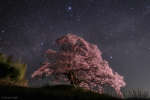 Summer Triangles over Japan
6.05.2015
Have you ever seen the Summer Triangle? The bright stars Vega, Deneb, and Altair form a large triangle on the sky that can be seen rising in the early northern early spring during the morning and rising in the northern fall during the evening.
|
January February March April May June July August September October |
|||||||||||||||||||||||||||||||||||||||||||||||||