
|
You entered: Earth
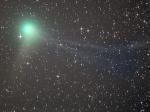 Announcing Comet Machholz
13.12.2004
A comet discovered only this summer is brightening quickly and already visible to the unaided eye. Comet C/2004 Q2 (Machholz) is currently best visible in Earth's Southern Hemisphere where some observers report it brighter than magnitude 5. The comet is moving rapidly to northern skies and should continue to brighten until early January.
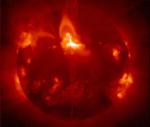 Active Regions, CMEs, and X Class Flares
8.06.2000
Space Weather forcasters are predicting major storm conditions over the next few days as the active Sun has produced at least three strong flares and a large coronal mass ejection (CME) since Tuesday, June 6th.
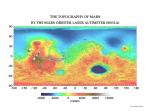 The Topography of Mars
28.06.2001
Mars has its ups and downs. Visible on the above interactive topographic map of the surface of Mars are giant volcanoes, deep valleys, impact craters, and terrain considered unusual and even mysterious. Particularly notable...
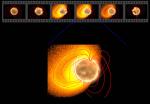 Galactic Magnetar Throws Giant Flare
21.02.2005
Was the brightest Galactic blast yet recorded a key to connecting two types of celestial explosions? Last December, a dense sheet of gamma rays only a few times wider than the Earth plowed through our Solar System, saturating satellites and noticeably reflecting off the Moon.
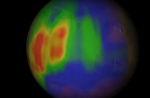 Mars Methane Mystery Deepens
22.04.2019
The methane mystery on Mars just got stranger. New results from ESA and Roscosmos' ExoMars Trace Gas Orbiter, has unexpectedly not detected methane in the atmosphere of Mars. This result follows the 2013 detection of methane by NASA's Curiosity rover, a result seemingly confirmed by ESA's orbiting Mars Express the next day.
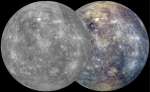 MESSENGER s First Day
8.10.2011
One solar day on a planet is the length of time from noon to noon. A solar day lasts 24 hours on planet Earth. On Mercury a solar day is about 176 Earth days long.
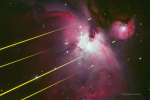 Nebula with Laser Beams
29.03.2017
Four laser beams cut across this startling image of the Orion Nebula, as seen from ESO's Paranal Observatory in the Atacama desert on planet Earth. Not part of an interstellar conflict, the lasers...
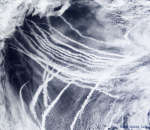 Ship Tracks over the Pacific Ocean
8.06.2022
What are those unusual streaks? Some images of planet Earth show clear bright streaks that follow the paths of ships. Known as ship tracks, these low and narrow bands are caused by the ship's engine exhaust.
 APOD: 2023 October 9 Б A Distorted Sunrise Eclipse
9.10.2023
Yes, but have you ever seen a sunrise like this? Here, after initial cloudiness, the Sun appeared to rise in two pieces and during a partial eclipse in 2019, causing the photographer to describe it as the most stunning sunrise of his life.
 Happy Birthday Jules Verne
15.02.2003
One hundred seventy-five years ago (on February 8th), Jules Verne was born in Nantes, France. Inspired by a lifelong fascination with machines, Verne wrote visionary works about "Extraordinary Voyages" including such terrestrial travels as Around the World in 80 Days, Journey to the Centre of the Earth, and Twenty Thousand Leagues Under the Sea.
|
January February March April May June July August September October |
|||||||||||||||||||||||||||||||||||||||||||||||||