
|
You entered: Earth
 Island Universe, Cosmic Sand
2.08.2003
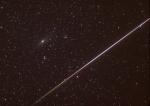
On August 13, 2002, while counting Perseid meteors under dark, early morning Arizona skies, Rick Scott set out to photograph their fleeting but fiery trails. The equipment he used included a telephoto lens and fast color film. After 21 pictures he'd caught only two meteors, but luckily this was one of them.
 Perseid Prelude
12.08.2010
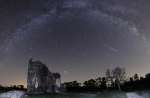
Each August, as planet Earth swings through dust trailing along the orbit of periodic comet Swift-Tuttle, skygazers can enjoy the Perseids Meteor Shower. The shower should build to its peak now, best seen from later tonight after moonset, until dawn tomorrow morning when Earth moves through the denser part of the wide dust trail.
 The Opposing Tails of Comet Garradd
28.02.2012
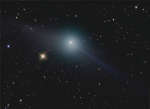
Why does Comet Garradd have two tails? Visible on the left, Comet Garradd's dust tail is composed of ice and dust bits that trial the comet in its orbit around the Sun. Visible...
 An Active Night over the Magellan Telescopes
21.02.2017
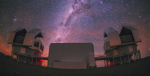
The night sky is always changing. Featured here are changes that occurred over a six hour period in late 2014 June behind the dual 6.5-meter Magellan Telescopes at Las Campanas Observatory in Chile.
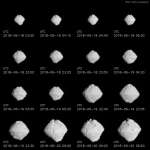 Hayabusa2 Approaches Asteroid Ryugu
25.06.2018
It looks like a big space diamond -- but with craters. It's 162173 Ryugu (Dragon's Castle), and Japan's robotic Hayabusa2 mission is now arriving at this near-Earth asteroid. Ambitious Hayabusa2 is carrying...
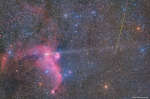 Meteor, Comet, and Seagull (Nebula)
21.10.2018
A meteor, a comet, and a photogenic nebula have all been captured in this single image. The closest and most fleeting is the streaking meteor on the upper right -- it was visible for less than a second.
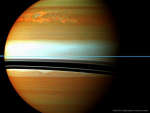 A Long Storm System on Saturn
15.09.2019
It was one of the largest and longest lived storms ever recorded in our Solar System. First seen in late 2010, the above cloud formation in the northern hemisphere of Saturn started larger than the Earth and soon spread completely around the planet.
 APOD: 2024 March 31 Б Total Solar Eclipse Below the Bottom of the World
31.03.2024
In late 2021 there was a total solar eclipse visible only at the end of the Earth. To capture the unusual phenomenon, airplanes took flight below the clouded seascape of Southern Ocean. The featured...
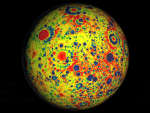 GRAIL Maps the Moons Gravity
19.03.2013
How did the Moon form? To help find out, NASA launched the twin Gravity Recovery and Interior Laboratory (GRAIL) satellites in 2011 to orbit and map the Moon's surface gravity in unprecedented detail.
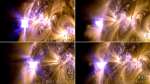 Four X-class Flares
16.05.2013
Swinging around the Sun's eastern limb on Monday, a group of sunspots labeled active region AR1748 has produced the first four X-class solar flares of 2013 in less than 48 hours. In time sequence clockwise from the top left, flashes from the four were captured in extreme ultraviolet images from the Solar Dynamics Observatory.
|
January February March April May June July August September October |
|||||||||||||||||||||||||||||||||||||||||||||||||