
|
You entered: Earth
 APOD: 2024 September 23 Б Comet Tsuchinshan ATLAS Approaches
23.09.2024
What will happen as this already bright comet approaches? Optimistic predictions have Comet C/2023 A3 (TsuchinshanБATLAS) briefly becoming easily visible to the unaided eye -- although the future brightness of comets are notoriously hard to predict, and this comet may even break up in warming sunlight.
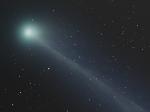 The Ghostly Tail of Comet SWAN
6.11.2006
What causes the structure in Comet SWAN's tail? Comet SWAN, which unexpectedly flared up to naked-eye brightness last week, has been showing detail in its ion tail that might be described as ghostly.
 Kepler s House in Linz
15.05.2018
Four hundred years ago today (May 15, 1618) Johannes Kepler discovered the simple mathematical rule governing the orbits of the solar system's planets, now recognized as Kepler's Third Law of planetary motion.
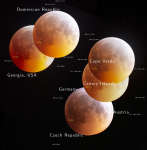 Lunar Eclipse Perspectives
5.02.2020
Do we all see the same Moon? Yes, but we all see it differently. One difference is the apparent location of the Moon against background stars -- an effect known as parallax. We humans use the parallax between our eyes to judge depth.
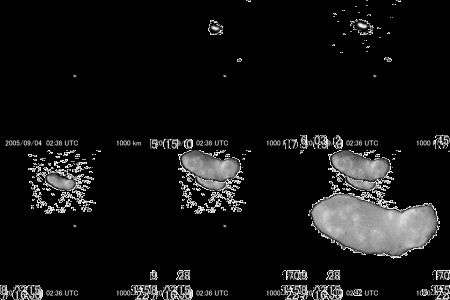 Approaching Asteroid Itokawa
19.09.2005
What are asteroids made of? To help find out, Japan's JAXA space agency launched the Hayabusa mission to rendezvous with asteroid Itokawa. Last week, the small robotic Hayabusa spacecraft arrived at asteroid Itokawa and stationed itself only 20 kilometers away.
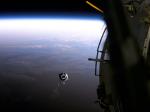 A Supply Ship Approaches the Space Station
23.04.2007
Looking out a window of the International Space Station brings breathtaking views. Visible vistas include a vast and colorful Earth, a deep dark sky, and an occasional spaceship sent to visit the station. Visible on September 20 of last year was a Soyuz TMA-9 spacecraft carrying not only supplies but also three new astronauts.
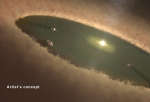 The Double Dust Disks of HD 95086
16.11.2014
What do other star systems look like? To help find out, astronomers are carrying out detailed observations of nearby stars in infrared light to see which have dust disks that might be forming planets.
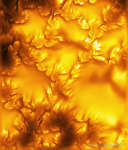 APOD: 2026 August 6 Б New Sharpest Image of the Sun Uncovers Instability
6.08.2026
What does the new sharpest image of our Sun show? Instability. To be clear, a certain kind of interactive process called the Kelvin-Helmholtz instability (KHI). This instability can create waves and swirls when two streams flow past each other -- in this case variable streams of solar magnetic plasma.
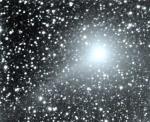 Comet Williams in 1998
6.10.1998
The brightest comet in the sky right now is Comet Williams. Moving slowly though the constellation of Centaurus, Comet Williams, at magnitude 8, is visible to Southern Hemisphere observers with binoculars. In ten days...
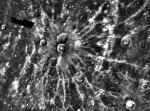 Degas Ray Crater on Mercury
8.12.1996
Like the Earth's Moon, Mercury is scarred with craters, testifying to an intense bombardment during the early history of the Solar System. In 1974, the Mariner 10 spacecraft surveyed this innermost planet up close, producing the only detailed images of its tortured surface.
|
January February March April May June July August September October |
|||||||||||||||||||||||||||||||||||||||||||||||||