
|
You entered: constellation
 The Day After Mars
1.11.2019
October 31, 1938 was the day after Martians encountered planet Earth, and everything was calm. Reports of the invasion were revealed to be part of a Halloween radio drama, the now famous broadcast based on H.G. Wells' scifi novel War of the Worlds.
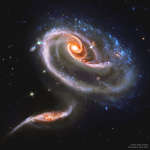 Arp 273: Battling Galaxies from Hubble
20.11.2019
What's happening to these spiral galaxies? Although details remain uncertain, there sure seems to be a titanic battle going on. The upper galaxy is labelled UGC 1810 by itself, but together with its collisional partners is known as Arp 273.
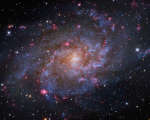 M33: The Triangulum Galaxy
31.12.2019
The small, northern constellation Triangulum harbors this magnificent face-on spiral galaxy, M33. Its popular names include the Pinwheel Galaxy or just the Triangulum Galaxy. M33 is over 50,000 light-years in diameter, third largest in the Local Group of galaxies after the Andromeda Galaxy (M31), and our own Milky Way.
 Iron in the Butterfly Nebula
21.07.2020
Can stars, like caterpillars, transform themselves into butterflies? No, but in the case of the Butterfly Nebula -- it sure looks like it. Though its wingspan covers over 3 light-years and its estimated surface temperature...
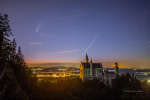 Fairytale NEOWISE
23.07.2020
Comet dust falls through a twilight sky in this dream-like scene, but it's not part of a fairytale movie. Still, Castle Neuschwanstein, nestled in the Bavarian Alps, did inspire Disneyland's Sleeping Beauty Castle. Captured on July 20, the bright streak above the castle towers is likely a Perseid meteor.
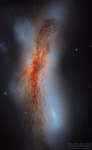 NGC 520: Colliding Galaxies from Hubble
7.09.2021
Is this one galaxy or two? The jumble of stars, gas, and dust that is NGC 520 is now thought to incorporate the remains of two separate disk galaxies. A defining component...
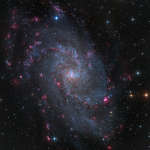 M33: The Triangulum Galaxy
12.11.2021
The small, northern constellation Triangulum harbors this magnificent face-on spiral galaxy, M33. Its popular names include the Pinwheel Galaxy or just the Triangulum Galaxy. M33 is over 50,000 light-years in diameter, third largest in the Local Group of galaxies after the Andromeda Galaxy (M31), and our own Milky Way.
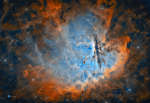 APOD: 2025 March 26 Б Star Formation in the Pacman Nebula
26.03.2025
You'd think the Pacman Nebula would be eating stars, but actually it is forming them. Within the nebula, a cluster's young, massive stars are powering the pervasive nebular glow. The eye-catching shapes...
 APOD: 2025 September 10 Б The Great Lacerta Nebula
10.09.2025
It is one of the largest nebulas on the sky -- why isn't it better known? Roughly the same angular size as the Andromeda Galaxy, the Great Lacerta Nebula can be found toward the constellation of the Lizard (Lacerta).
 NGC 6888: The Crescent Nebula
28.11.2025
NGC 6888, also known as the Crescent Nebula, is a about 25 light-years across, a cosmic bubble blown by winds from its central, massive star. This deep telescopic image includes narrowband image data, to isolate light from hydrogen and oxygen atoms.
|
January February March April May June July August September October |
|||||||||||||||||||||||||||||||||||||||||||||||||