
|
You entered: constellation
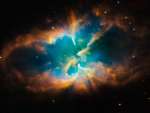 Planetary Nebula NGC 2818
22.01.2009
NGC 2818 is a beautiful planetary nebula, the gaseous shroud of a dying sun-like star. It could well offer a glimpse of the future that awaits our own Sun after spending another 5 billion years or so steadily using up hydrogen at its core, and then finally helium, as fuel for nuclear fusion.
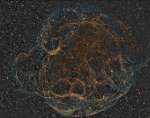 Simeis 147: Supernova Remnant
31.01.2009
It's easy to get lost following the intricate filaments in this detailed image of faint supernova remnant Simeis 147. Also cataloged as Sh2-240 and seen towards the constellation Taurus, it covers nearly 3 degrees (6 full moons) on the sky.
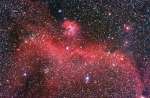 The Seagull Nebula
27.03.2009
Images from two different cameras, a digital SLR and an astronomical ccd camera, are combined in this color starscape. Both cameras made use of the same telescope at the oceanside Winter Star Party in the Florida Keys, appropriately creating this portrait of the Seagull Nebula.
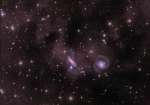 Dust and the NGC 7771 Group
21.01.2010
Galaxies of the NGC 7771 Group are featured in this intriguing skyscape. Some 200 million light-years distant toward the constellation Pegasus, NGC 7771 is the large, edge-on spiral near center, about 75,000 light-years across, with two smaller galaxies just below it. Large spiral NGC 7769 is seen face-on to the right.
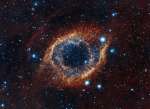 The Helix Nebula from the VISTA Telescope
31.01.2012
Will our Sun look like this one day? The Helix Nebula is one of brightest and closest examples of a planetary nebula, a gas cloud created at the end of the life of a Sun-like star.
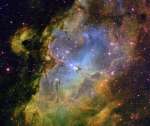 The Eagle Nebula from Kitt Peak
16.04.2012
From afar, the whole thing looks like an Eagle. A closer look at the Eagle Nebula, however, shows the bright region is actually a window into the center of a larger dark shell of dust. Through this window, a brightly-lit workshop appears where a whole open cluster of stars is being formed.
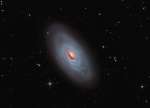 M64: The Black Eye Galaxy
4.04.2013
This beautiful, bright, spiral galaxy is Messier 64, often called the Black Eye Galaxy or the Sleeping Beauty Galaxy for its heavy-lidded appearance in telescopic views. M64 is about 17 million light-years distant in the otherwise well-groomed northern constellation Coma Berenices.
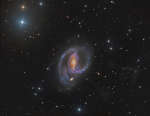 The Jets of NGC 1097
14.11.2013
Enigmatic spiral galaxy NGC 1097 shines in southern skies, about 45 million light-years away in the chemical constellation Fornax. Its blue spiral arms are mottled with pinkish star forming regions in this colorful galaxy portrait.
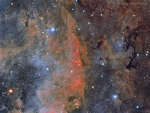 Colorful Star Clouds in Cygnus
22.04.2015
Stars can form in colorful surroundings. Featured here is a star forming region rich in glowing gas and dark dust toward the constellation of the Swan (Cygnus), near the bright star Sadr. This region, which spans about 50 light years, is part of the Gamma Cygni nebula which lies about 1,800 light years distant.
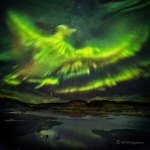 A Phoenix Aurora over Iceland
16.03.2016
All of the other aurora watchers had gone home. By 3:30 am in Iceland, on a quiet night last September, much of that night's auroras had died down. Suddenly though, a new burst of particles streamed down from space, lighting up the Earth's atmosphere once again.
|
January February March April May June July August September October |
|||||||||||||||||||||||||||||||||||||||||||||||||