
|
You entered: constellation
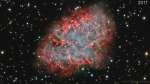 M1: The Incredible Expanding Crab Nebula
19.01.2020
Are your eyes good enough to see the Crab Nebula expand? The Crab Nebula is cataloged as M1, the first on Charles Messier's famous list of things which are not comets. In fact...
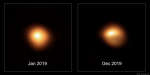 The Changing Surface of Fading Betelgeuse
17.02.2020
Besides fading, is Betelgeuse changing its appearance? Yes. The famous red supergiant star in the familiar constellation of Orion is so large that telescopes on Earth can actually resolve its surface -- although just barely.
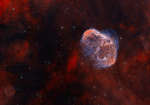 Cygnus: Bubble and Crescent
17.10.2020
These clouds of gas and dust drift through rich star fields along the plane of our Milky Way Galaxy toward the high flying constellation Cygnus. Caught within the telescopic field of view are the Soap Bubble (lower left) and the Crescent Nebula (upper right).
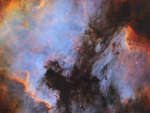 North America and the Pelican
16.09.2021
Fans of our fair planet might recognize the outlines of these cosmic clouds. On the left, bright emission outlined by dark, obscuring dust lanes seems to trace a continental shape, lending the popular name North America Nebula to the emission region cataloged as NGC 7000.
 Pillars of Creation
20.10.2022
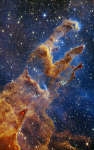
A now famous picture from the Hubble Space Telescope featured these star forming columns of cold gas and dust light-years long inside M16, the Eagle Nebula, dubbed the Pillars of Creation. This James Webb Space Telescope NIRCam image expands Hubble's exploration of that region in greater detail and depth inside the iconic stellar nursery.
 APOD: 2025 September 18 Б Comet C/2025 R2 SWAN
18.09.2025
A new visitor from the outer Solar System, comet C/2025 R2 (SWAN) also known as SWAN25B was only discovered late last week, on September 11. That's just day before the comet reached perihelion, its closest approach to the Sun.
 APOD: 2026 September 21 Б Cocoon Nebula Wide Field
21.09.2026
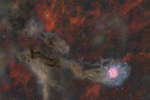
When does a nebula look like a comet? In this crowded starfield covering over two degrees within the high-flying constellation of the Swan (Cygnus), the eye is drawn to the Cocoon Nebula. A compact...
 Comet C 2002 T7 (LINEAR)
22.04.2004
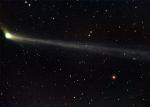
Discovered by the the Lincoln Near Earth Asteroid Research (LINEAR) project in October of 2002, comet C/2002 T7 is now visiting the inner solar system, making its closest approach (see animation by L. Koehn) to the Sun tomorrow, April 23rd.
 NGC 6302: Big Bright Bug Nebula
5.05.2004
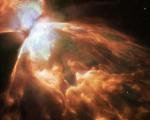
The bright clusters and nebulae of planet Earth's night sky are often named for flowers or insects, and NGC 6302 is no exception. With an estimated surface temperature of about 250,000 degrees...
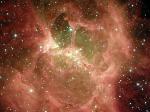 Spooky Star Forming Region DR 6
1.11.2004
How could stars form such a spooky and familiar shape as a human skull? First, the complex process of star formation creates nebulas of many shapes and sizes -- it is human perception that identifies the skull shape.
|
January February March April May June July August September October |
|||||||||||||||||||||||||||||||||||||||||||||||||