
|
You entered: dust
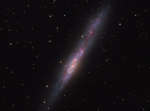 Irregular Galaxy NGC 55
21.09.2018
Irregular galaxy NGC 55 is thought to be similar to the Large Magellanic Cloud (LMC). But while the LMC is about 180,000 light-years away and is a well known satellite of our own Milky Way Galaxy, NGC 55 is more like 6 million light-years distant and is a member of the Sculptor Galaxy Group.
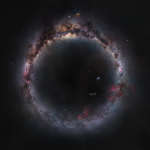 The Milky Ring
22.01.2021
An expanse of cosmic dust, stars and nebulae along the plane of our Milky Way galaxy form a beautiful ring in this projected all-sky view. The creative panorama covers the entire galaxy visible from planet Earth, an ambitious 360 degree mosaic that took two years to complete.
 APOD: 2024 May 5 Б A Black Hole Disrupts a Passing Star
5.05.2024
What happens to a star that goes near a black hole? If the star directly impacts a massive black hole, then the star falls in completely -- and everything vanishes. More likely, though, the star goes close enough to have the black hole's gravity pull away its outer layers, or disrupt, the star.
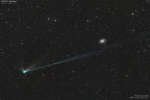 APOD: 2026 February 17 Б Tails of Comet Wierzchoе
17.02.2026
Some comets are regular guests of our solar neighborhood; others come by only once, never to return. We wonБt have another chance to see Comet C/2024 E1 (Wierzchoе), which is currently making its way through the inner Solar System. The hyperbolic orbit of this comet indicates that it will likely become an interstellar traveler.
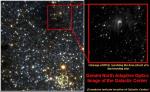 Gemini North Images Bow Shock Near Galactic Center
17.10.2000
What's going on near the center of our Galaxy? Glowing across the electromagnetic spectrum, the center of our Milky Way Galaxy is thought to be home to massive stars, rotating gas rings, and a massive black hole. Now the central Galactic zoo just got larger.
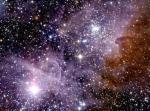 The Keyhole Nebula in Infrared
13.06.2000
About three million years ago, the stars in the Keyhole Nebula began to form. The above picture of the Keyhole Nebula, also known as the Carina Nebula or NGC 3372, shows in infrared light many facets of this dramatic stellar nursery which lies only 9,000 light-years away.
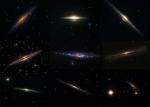 Spirals On Edge
10.05.2001
Spiral galaxies viewed face-on display a grand design, with graceful spiral arms traced by bright star clusters and glowing stellar nurseries. When seen edge-on, their appearance is very different but no less striking as their central regions bulge and dark cosmic dust lanes appear silhouetted against starlight from flattened galactic disks.
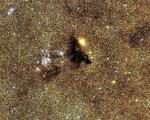 Open Cluster NGC 6520 from CFHT
22.07.2002
Did you ever have a day when it felt like a dark cloud was following you around? For the open cluster of stars NGC 6520, every day is like this. On the left of the above picture are many of NGC 6520's bright blue stars.
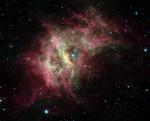 Cosmic Construction Zone RCW 49
3.06.2004
Stars and planets appear to be under construction in dusty nebula RCW 49. This Spitzer Space Telescope false-color infrared view of the nearby stellar nursery shows that known, hot stars are well on their way to clearing out the nebula's central regions.
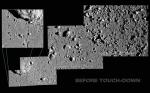 NEAR at Eros: Before Touchdown
12.02.2005
On 12 February, 2001, the NEAR-Shoemaker spacecraft gently touched-down on the the surface of Eros -- the first ever landing on an asteroid. During the descent, the spacecraft's camera recorded successive images of the diminutive world's surface, revealing fractured boulders, dust filled craters, and a mysterious collapsed channel.
|
January February March April May June July August September October |
|||||||||||||||||||||||||||||||||||||||||||||||||