
|
You entered: dust
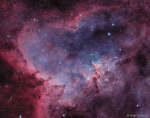 In the Heart of the Heart Nebula
14.02.2018
What's that inside the Heart Nebula? First, the large emission nebula dubbed IC 1805 looks, in whole, like a human heart. It's shape perhaps fitting of the Valentine's Day, this heart glows brightly in red light emitted by its most prominent element: hydrogen.
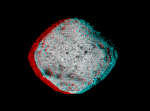 3D Bennu
13.12.2018
Put on your red/blue glasses and float next to asteroid 101955 Bennu. Shaped like a spinning top toy with boulders littering its rough surface, the tiny Solar System world is about 1 Empire State Building (less than 500 meters) across.
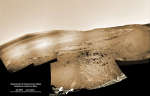 Opportunity at Perseverance Valley
15.02.2019
Opportunity had already reached Perseverance Valley by June of 2018. Its view is reconstructed in a colorized mosaic of images taken by the Mars Exploration Rover's Navcam. In fact, Perseverance Valley is an appropriate name for the destination.
 APOD: 2023 March 14 Б W5: The Soul Nebula
14.03.2023
Stars are forming in the Soul of the Queen of Aethopia. More specifically, a large star forming region called the Soul Nebula can be found in the direction of the constellation Cassiopeia, whom Greek mythology credits as the vain wife of a King who long ago ruled lands surrounding the upper Nile river.
 NGC 6302: The Butterfly Nebula
6.06.2025
The bright clusters and nebulae of planet Earth's night sky are often given the names of flowers or insects, and its whopping 3 light-year wingspan, NGC 6302 is no exception. With an estimated...
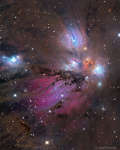 APOD: 2026 May 19 Б NGC 2170: The Angel Nebula
19.05.2026
Is this a painting or a photograph? In this celestial abstract art composed with a cosmic brush, dusty nebula NGC 2170, also known as the Angel Nebula, shines just above the image center. Reflecting...
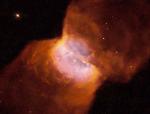 NGC 2346: A Butterfly-Shaped Planetary Nebula
28.10.2001
It may look like a butterfly, but it's bigger than our Solar System. NGC 2346 is a planetary nebula made of gas and dust that has evolved into a familiar shape. At the heart of the bipolar planetary nebula is a pair of close stars orbiting each other once every sixteen days.
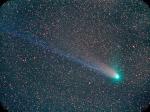 The Tails of Comet NEAT Q4
12.05.2004
Comet NEAT (Q4) is showing its tails. As the large snowball officially dubbed Comet C/2001 Q4 (NEAT) falls toward the inner Solar System, it has already passed the Earth and will reach its closest approach to the Sun this coming Saturday.
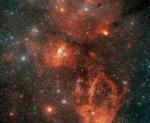 NGC 7635: Bubble in a Cosmic Sea
28.04.2006
Seemingly adrift in a cosmic sea of stars and glowing gas, the delicate, floating apparition near the center (next to a blue tinted star) of this widefield view is cataloged as NGC 7635 - The Bubble Nebula.
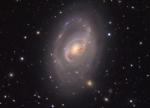 Messier 96
15.06.2007
Dust lanes seem to swirl around the core of Messier 96 in this colorful, detailed portrait of the beautiful island universe. Of course M96 is a spiral galaxy, and counting the faint arms extending beyond the brighter central region it spans 100 thousand light-years or so, about the size of our own Milky Way.
|
January February March April May June July August September October |
|||||||||||||||||||||||||||||||||||||||||||||||||