
|
You entered: dust
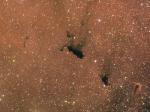 Molecular Cloud Barnard 163
21.03.2007
It may look to some like a duck, but it lays stars instead of eggs. In the center of the above image lies Barnard 163, a nebula of molecular gas and dust so thick that visible light can't shine through it.
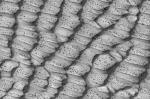 APOD: 2007 August 5- The Dotted Dunes of Mars
5.08.2007
What causes the black dots on dunes on Mars? As spring dawned on the Northern Hemisphere of Mars in 2004, dunes of sand near the poles begin to defrost. Thinner regions of ice typically thaw first revealing sand whose darkness soaks in sunlight and accelerates the thaw.
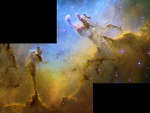 The Eagle Nebula in Hydrogen Oxygen, and Silicon
27.02.2008
Bright blue stars are still forming in the dark pillars of the Eagle Nebula. Made famous by a picture from the Hubble Space Telescope in 1995, the Eagle Nebula shows the dramatic process of star formation.
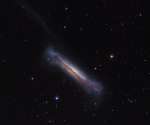 Sideways Galaxy NGC 3628
16.03.2011
Dark dust lanes cut across the middle of this gorgeous island universe, a strong hint that NGC 3628 is a spiral galaxy seen sideways. About 35 million light-years away in the northern springtime constellation...
 Arp 78: Peculiar Galaxy in Aries
7.07.2011
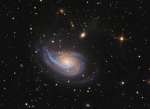
Peculiar spiral galaxy Arp 78 is found within the boundaries of the head strong constellation Aries, some 100 million light-years beyond the stars and nebulae of our Milky Way galaxy. Also known...
 A Zodiacal Skyscape
23.02.2012
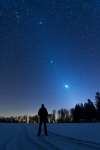
Venus and Jupiter are this month's two brightest planets. Shortly after sunset on February 20, they dominate the sky above the western horizon and this snowy landscape. In clear and transparent skies over Cherry Springs State Park, Pennsylvania, USA, they are also seen immersed in Zodiacal light.
 NGC 602 and Beyond
13.01.2013
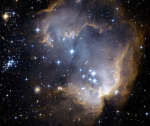
Near the outskirts of the Small Magellanic Cloud, a satellite galaxy some 200 thousand light-years distant, lies 5 million year young star cluster NGC 602. Surrounded by natal gas and dust, NGC 602 is featured in this stunning Hubble image of the region.
 Delphinid Meteor Mystery
15.06.2013
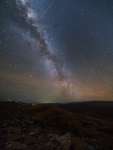
Over a five hour period last Tuesday morning, exposures captured this tantalizing view of meteor streaks and the Milky Way in dark skies above Las Campanas Observatory in Chile. During that time, astronomers...
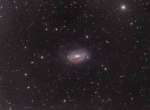 M63: Sunflower Galaxy Wide Field
4.08.2016
The Sunflower Galaxy blooms near the center of this wide field telescopic view. The scene spans about 2 degrees or 4 full moons on the sky toward the loyal constellation Canes Venatici. More formally...
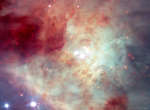 Fast Stars and Rogue Planets in the Orion Nebula
21.03.2017
Start with the constellation of Orion. Below Orion's belt is a fuzzy area known as the Great Nebula of Orion. In this nebula is a bright star cluster known as the Trapezium, marked by four bright stars near the image center.
|
January February March April May June July August September October |
|||||||||||||||||||||||||||||||||||||||||||||||||