
|
You entered: telescope
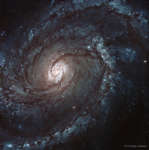 M100: A Grand Design Spiral Galaxy
10.02.2015
Majestic on a truly cosmic scale, M100 is appropriately known as a grand design spiral galaxy. It is a large galaxy of over 100 billion stars with well-defined spiral arms that is similar to our own Milky Way Galaxy.
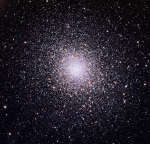 Messier 5
9.05.2019
"Beautiful Nebula discovered between the Balance [Libra] & the Serpent [Serpens] ..." begins the description of the 5th entry in 18th century astronomer Charles Messier's famous catalog of nebulae and star clusters. Though it appeared...
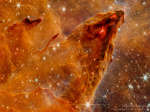 M16: A Star Forming Pillar from Webb
6.12.2022
WhatБs happening inside this interstellar mountain? Stars are forming. The mountain is actually a column of gas and dust in the picturesque Eagle Nebula (M16). A pillar like this is so low in density that you could easily fly though it -- it only appears solid because of its high dust content and great depth.
 APOD: 2023 September 3 Б Comet Schwassmann Wachmann 3 Fragments
3.09.2023
Periodic comet 73P/Schwassmann-Wachmann 3 has broken up at least twice. A cosmic souffle of ice and dust left over from the early solar system, this comet was first seen to split into several large pieces during the close-in part of its orbit in 1995.
 APOD: 2024 January 8 Б The Phases of Venus
8.01.2024
Venus goes through phases. Just like our Moon, Venus can appear as a full circular disk, a thin crescent, or anything in between. Venus, frequently the brightest object in the post-sunset or pre-sunrise sky, appears so small, however, that it usually requires binoculars or a small telescope to clearly see its current phase.
 Reflections on VdB 31
13.02.2025
Riding high in the constellation of Auriga, beautiful, blue VdB 31 is the 31st object in Sidney van den Bergh's 1966 catalog of reflection nebulae. It shares this well-composed celestial still life with dark, obscuring clouds B26, B27, and B28, recorded in Edward E. Barnard's 1919 catalog of dark markings in the sky.
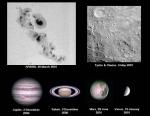 Solar System Web Cam
14.07.2001
Ranging throughout the solar system, these pictures all have something in common. They were taken with an 8 inch diameter telescope, a size popular with amateur astronomy buffs, and slightly modified "web cam" of the type widely used to send images out over the internet.
 A Distant Galaxy in the Deep Field
28.06.1996
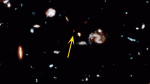
Researchers believe that the faint reddish smudge indicated by the arrow in the image above is a candidate for the most distant known galaxy which may have existed only a few hundred million years after the Big Bang.
 Moon and Planets Sky
26.03.2004
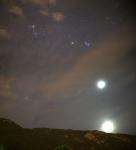
Look up into the sky tonight and without a telescope or binoculars you might have a view like this one of Moon, planets and stars. The lovely photo was taken on March 23rd, and captures the crescent Moon on the horizon with Venus above it. Both brilliant celestial bodies are over-exposed.
 NGC 346 in the Small Magellanic Cloud
18.01.2005
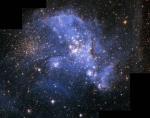
A satellite galaxy of the Milky Way, the Small Magellanic Cloud (SMC) is a wonder of the southern sky, a mere 210,000 light-years distant in the constellation Tucana. Found among the SMC's clusters and nebulae NGC 346 is a star forming region about 200 light-years across, pictured above by the Hubble Space Telescope.
|
January February March April May June July August September October |
|||||||||||||||||||||||||||||||||||||||||||||||||