
|
You entered: telescope
 A GRB Host?
25.06.1997
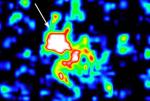
Where do gamma-ray bursts (GRBs) originate? The most powerful explosions in the universe have recently been located with record accuracy. But do GRBs occur in galaxies or out alone in deep space? This picture taken with the Hubble Space Telescope of the field surrounding GRB 970228 might provide a clue.
 Resolving Mira
13.08.1997
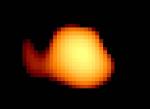
Most stars appear only as points of light. Recently, Betelgeuse became the second star, after our Sun, to have it surface resolved. Now add Mira to the list. Mira A is a red giant star undergoing dramatic pulsations, causing it to become more than 100 times brighter over the course of a year.
 NGC 6070: First Light for Sloan
10.06.1998
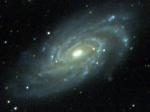
The graceful spiral galaxy NGC 6070, 100 million light-years distant in the constellation Serpens, is helping astronomers celebrate "First Light" (the first test sky images) for an exciting new telescope built to perform the ambitious Sloan Digital Sky Survey.
 Massive Star Forming Region DR21 in Infrared
14.04.2004
Deep in the normally hidden recesses of giant molecular cloud DR21, a stellar nursery has been found creating some of the most massive stars yet recorded. The orbiting Spitzer Space Telescope's Infrared Array Camera opened the window into the cloud last year in mid- infrared light.
 The Trifid Nebula from Hubble
18.06.2004
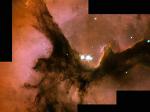
Clouds of glowing gas mingle with lanes of dark dust in the Trifid Nebula, a star forming region toward the constellation of Sagittarius. In the center, the three huge dark dust lanes that give the Trifid its name all come together.
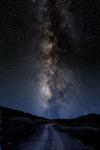 The Milky Road
20.10.2007
Inspired during a visit to Fort Davis, Texas, home of McDonald Observatory and dark night skies, photographer Larry Landolfi created this tantalizing fantasy view. The composited image suggests the Milky Way is a heavenly extension of a deserted country road.
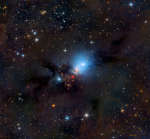 NGC 1333 Stardust
6.03.2014
NGC 1333 is seen in visible light as a reflection nebula, dominated by bluish hues characteristic of starlight reflected by dust. A mere 1,000 light-years distant toward the heroic constellation Perseus, it lies at the edge of a large, star-forming molecular cloud.
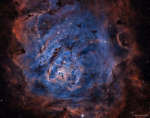 The Lagoon Nebula in Hydrogen Sulfur and Oxygen
5.01.2016
The majestic Lagoon Nebula is filled with hot gas and the home for many young stars. Spanning 100 light years across while lying only about 5000 light years distant, the Lagoon Nebula is so big and bright that it can be seen without a telescope toward the constellation of the Archer (Sagittarius).
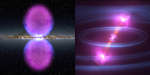 Fermi Science Finals
23.07.2018
The Fermi Science Playoffs celebrate 10 years of the Fermi Gamma-ray Space Telescope's exploration of the high-energy universe. Surviving all early rounds of voting, these two finalists in the competion square off at last.
 A Halo for Andromeda
3.09.2020
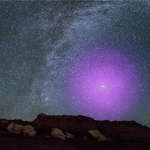
M31, the Andromeda Galaxy, is the closest large spiral galaxy to our Milky Way. Some 2.5 million light-years distant it shines in Earth's night sky as a small, faint, elongated cloud just visible to the unaided eye.
|
January February March April May June July August September October |
|||||||||||||||||||||||||||||||||||||||||||||||||