
|
You entered: telescope
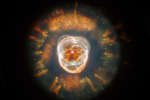 The Eskimo Nebula from Hubble
3.05.2009
In 1787, astronomer William Herschel discovered the Eskimo Nebula. From the ground, NGC 2392 resembles a person's head surrounded by a parka hood. In 2000, the Hubble Space Telescope imaged the Eskimo Nebula. From space, the nebula displays gas clouds so complex they are not fully understood.
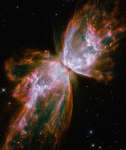 The Butterfly Nebula from Upgraded Hubble
10.09.2009
The bright clusters and nebulae of planet Earth's night sky are often named for flowers or insects, and NGC 6302 is no exception. With an estimated surface temperature of about 250,000 degrees...
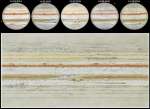 Jupiter Unplugged
2.03.2012
Five hand drawn sketches of Jupiter were used to create this beautifully detailed flat map of the ruling gas giant's turbulent cloud tops. Made with colored pencils at the eyepiece of a 16 inch diameter telescope, the original drawings are about 5 inches (12.5 cm) in diameter.
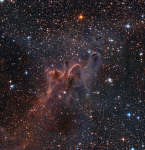 Cometary Globules
12.10.2013
Bright-rimmed, flowing shapes gather near the center of this rich starfield toward the boarders of the nautical southern constellations Pupis and Vela. Composed of interstellar gas and dust, the grouping of light-year sized cometary globules is about 1300 light-years distant.
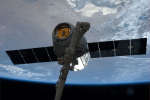 The Space Station Captures a Dragon Capsule
2.06.2014
The space station has caught a dragon. Specifically, in mid-April, the International Space Station captured the unmanned SpaceX Dragon capsule sent to resupply the orbiting outpost. Pictured above, the station's Canadarm2 had just grabbed the commercial spaceship.
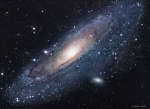 M31: The Andromeda Galaxy
30.08.2015
What is the nearest major galaxy to our own Milky Way Galaxy? Andromeda. In fact, our Galaxy is thought to look much like Andromeda. Together these two galaxies dominate the Local Group of galaxies. The diffuse light from Andromeda is caused by the hundreds of billions of stars that compose it.
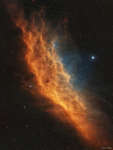 NGC 1499: The California Nebula
6.11.2018
There's even a California in space. Drifting through the Orion Arm of the spiral Milky Way Galaxy, this cosmic cloud by chance echoes the outline of California on the west coast of the United States.
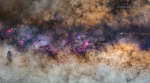 The Annotated Galactic Center
27.09.2019
The center of our Milky Way galaxy can be found some 26,000 light-years away toward the constellation Sagittarius. Even on a dark night, you can't really see it though. Gaze in that direction, and your sight-line is quickly obscured by intervening interstellar dust.
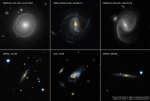 Spiral Galaxies Spinning Super Fast
5.11.2019
Why are these galaxies spinning so fast? If you estimated each spiral's mass by how much light it emits, their fast rotations should break them apart. The leading hypothesis as to why these galaxies don't break apart is dark matter -- mass so dark we can't see it.
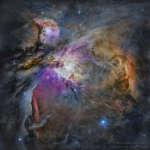 Orion Nebula: The Hubble View
29.06.2021
Few cosmic vistas excite the imagination like the Orion Nebula. Also known as M42, the nebula's glowing gas surrounds hot young stars at the edge of an immense interstellar molecular cloud only 1,500 light-years away.
|
January February March April May June July August September October |
|||||||||||||||||||||||||||||||||||||||||||||||||