
|
You entered: telescope
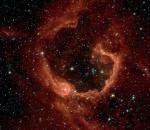 RCW 79: Stars in a Bubble
15.04.2005
A cosmic bubble of gas and dust, RCW 79 has grown to about 70 light-years in diameter, blown by the winds and radiation from hot young stars. Infrared light from the dust embedded in the nebula is tinted red in this gorgeous false-color view from the Spitzer Space Telescope.
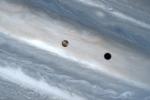 Io Shadow
23.04.1999
Orbiting Jupiter once every 43 hours, the volcanic moon Io cruises 500,000 kilometers above swirling, banded cloud-tops. Orbiting Earth once every 1.5 hours, the Hubble Space Telescope watched as Io accompanied by its shadow crossed the face of the reigning gas giant planet in 1997.
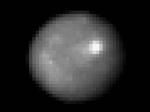 Ceres: Asteroid or Planet
21.08.2006
Is Ceres an asteroid or a planet? Although a trivial designation to some, the recent suggestion by the Planet Definition Committee of the International Astronomical Union would have Ceres reclassified from asteroid to planet. A change in taxonomy might lead to more notoriety for the frequently overlooked world.
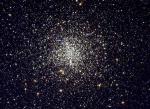 M4: The Closest Known Globular Cluster
23.05.2000
M4 is a globular cluster visible in dark skies about one degree west of the bright star Antares in the constellation Scorpius. M4 is perhaps the closest globular cluster at 7000 light years, meaning that we see M4 only as it was 7000 years ago, near the dawn of recorded human history.
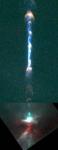 HH111's 12 Light-Year Star Jet
21.03.2000
The complex interactions of three stars in the Orion B molecular cloud complex have resulted in the ejection of particles along a 12 light-year long jet. One of the stars in the HH111 system has apparently also been ejected leaving two stars tightly bound in a binary orbit.
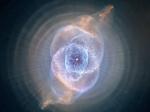 The Cats Eye Nebula from Hubble
13.05.2007
Staring across interstellar space, the alluring Cat's Eye nebula lies three thousand light-years from Earth. A classic planetary nebula, the Cat's Eye (NGC 6543) represents a final, brief yet glorious phase in the life of a sun-like star.
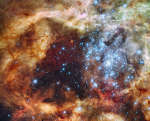 Star Cluster R136 Bursts Out
21.12.2009
In the center of star-forming region 30 Doradus lies a huge cluster of the largest, hottest, most massive stars known. These stars, known collectively as star cluster R136, were captured above in visible light by the newly installed Wide Field Camera peering though the recently refurbished Hubble Space Telescope.
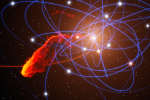 The Diner at the Center of the Galaxy
30.12.2011
The monster at the center of our Galaxy is about to get fed. Recent observations by the Very Large Telescopes indicate that a cloud of gas will venture too close to the supermassive black hole at the Galactic center.
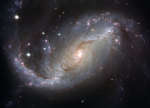 Spiral Galaxy NGC 1672 from Hubble
13.05.2012
Many spiral galaxies have bars across their centers. Even our own Milky Way Galaxy is thought to have a modest central bar. Prominently barred spiral galaxy NGC 1672, pictured above, was captured in spectacular detail in image taken by the orbiting Hubble Space Telescope.
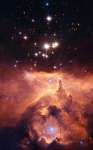 NGC 6357s Cathedral to Massive Stars
18.11.2012
How massive can a normal star be? Estimates made from distance, brightness and standard solar models had given one star in the open cluster Pismis 24 over 200 times the mass of our Sun, nearly making it the record holder.
|
January February March April May June July August September October |
|||||||||||||||||||||||||||||||||||||||||||||||||