
|
You entered: telescope
 APOD: 2023 December 6 Б Stars Verus Dust in the Carina Nebula
6.12.2023
It's stars versus dust in the Carina Nebula and the stars are winning. More precisely, the energetic light and winds from massive newly formed stars are evaporating and dispersing the dusty stellar nurseries in which they formed.
 Jupiter over 2 Hours and 30 Minutes
19.01.2024
Jupiter, our Solar System's ruling gas giant, is also the fastest spinning planet, rotating once in less than 10 hours. The gas giant doesn't rotate like a solid body though.
 APOD: 2025 April 9 Б HH 49: Interstellar Jet from Webb
9.04.2025
What's at the tip of this interstellar jet? First let's consider the jet: it is being expelled by a star system just forming and is cataloged as Herbig-Haro 49 (HH 49). The star system expelling this jet is not visible -- it is off to the lower right.
 The Center of Centaurus A
22.05.1998
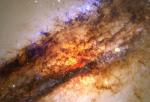
A fantastic jumble of young blue star clusters, gigantic glowing gas clouds, and imposing dark dust lanes surrounds the central region of the active galaxy Centaurus A. This mosaic of Hubble Space Telescope images taken in blue, green, and red light has been processed to present a natural color picture of this cosmic maelstrom.
 SM3B: Mission to Hubble
14.03.2002
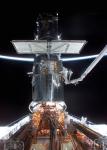
Now complete, Servicing Mission 3B (SM3B) was really the fourth trip to the Hubble Space Telescope, as the originally planned mission 3 was split into two parts. Falling around planet Earth, about 320 nautical...
 A Quasar-Galaxy Collision?
22.10.1995
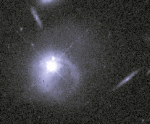
In 1963 astronomers were astounded to discover that certain faint, star-like objects have very large redshifts. The large redshifts imply that these objects, now known as quasars (QUASi-stellAR objects), lie near the edge of the observable Universe.
 The Tarantula and the Supernova
27.10.1995
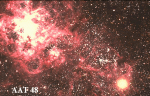
In this close-up of the Large Magellanic Cloud, the spidery looking nebula on the left is fittingly known as as the Tarantula nebula. It is an emission nebula surrounding a cluster of hot, young stars called the 30 Doradus super cluster.
 Name This Satellite
20.04.1998
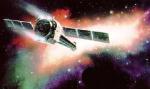
Can you name this satellite? In December, NASA's third Great Observatory is planned for launch. The two NASA Great Observatories currently in orbit are the Hubble Space Telescope and the Compton Gamma-Ray Observatory, both now named for famous scientists. But after whom should the Advanced X-ray Astrophysics Facility (AXAF) be named?
 Saturn by Three
18.09.2003
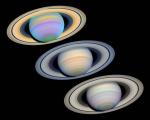
These three views of Saturn were recorded by the Hubble Space Telescope on March 7th of this year, as the southern hemisphere of the solar system's most gorgeous planet reached its maximum 27 degree tilt toward Earth.
 NGC 613: Spiral of Dust and Stars
13.02.2004
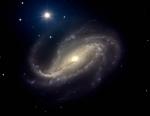
When morning twilight came to the Paranal Observatory in Chile, astronomers Mark Neeser and Peter Barthel interrupted their search for faint quasars, billions of light-years away. And just for a moment, they used Very Large Telescopes at the European Southern Observatory to appreciate the beauty of the nearby Universe.
|
January February March April May June July August September October |
|||||||||||||||||||||||||||||||||||||||||||||||||