
|
You entered: color
 APOD: 2025 January 6 Б Colliding Spiral Galaxies from Webb and Hubble
6.01.2025
Billions of years from now, only one of these two galaxies will remain. Until then, spiral galaxies NGC 2207 and IC 2163 will slowly pull each other apart, creating tides of matter, sheets of shocked gas, lanes of dark dust, bursts of star formation, and streams of cast-away stars.
 APOD: 2025 June 1 Б UGC 1810: Wildly Interacting Galaxy from Hubble
1.06.2025
What's happening to this spiral galaxy? Although details remain uncertain, it surely has to do with an ongoing battle with its smaller galactic neighbor. The featured galaxy is labelled UGC 1810 by itself, but together with its collisional partner is known as Arp 273.
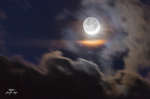 APOD: 2026 April 24 Б Young Moon and Sister Stars
24.04.2026
Sunlit arms of a crescent moon seem to embrace the faint lunar night side in this dramatic celestial scene from planet Earth. The single telephoto exposure tracking the sky was captured on the night of April 19, when a two day old Moon was near perigee in its elliptical orbit.
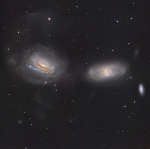 APOD: 2026 May 18 Б Unraveling NGC 3169
18.05.2026
Spiral galaxy NGC 3169 looks to be unraveling like a ball of cosmic yarn. It lies some 70 million light-years away, south of bright star Regulus toward the faint constellation Sextans. Wound up spiral arms are pulled out into sweeping tidal tails as NGC 3169 (left) and neighboring NGC 3166 interact gravitationally.
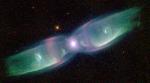 M2-9: Wings of a Planetary Nebula
23.12.1997
Are stars better appreciated for their art after they die? Actually, stars usually create their most artistic displays as they die. In the case of low-mass stars like our Sun and M2-9 pictured above, the stars transform themselves from normal stars to white dwarfs by casting off their outer gaseous envelopes.
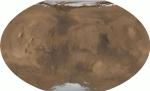 All of Mars
26.06.2001
From pole to pole, from east to west, this is all of Mars. The above picture was digitally reconstructed from over 200 million laser altimeter measurements taken by the Mars Global Surveyor spacecraft currently orbiting Mars.
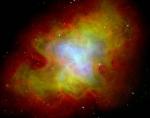 The Crab Nebula Pulsar Shrugs
20.09.2002
How does a city-sized neutron star power the vast Crab Nebula? The expulsion of wisps of hot gas at high speeds appears to be at least part of the answer. Yesterday time-lapse movies taken...
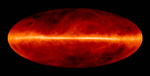 A Sky Full Of Hydrogen
18.12.1996
Interstellar space is filled with extremely tenuous clouds of gas which are mostly Hydrogen. The neutral hydrogen atom (HI in astronomer's shorthand) consists of 1 proton and 1 electron. The proton and electron spin like tops but can have only two orientations; spin axes parallel or anti-parallel.
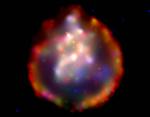 72.6: Oxygen Supply
28.05.2003
A supernova explosion, a massive star's inevitable and spectacular demise, blasts back into space debris enriched in the heavy elements forged in its stellar core. Incorporated into future stars and planets, these are the elements ultimately necessary for life.
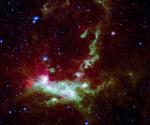 Henize 206: Cosmic Generations
11.03.2004
Peering into a dusty nebula in nearby galaxy the Large Magellanic Cloud, infrared cameras on board the Spitzer Space Telescope recorded this detailed view of stellar nursery Henize 206 filled with newborn stars. The stars appear as white spots within the swirls of dust and gas in the false-color infrared image.
|
January February March April May June July August September October |
|||||||||||||||||||||||||||||||||||||||||||||||||