
|
You entered: color
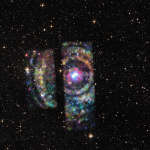 X ray Echoes from Circinus X 1
5.08.2015
Circinus X-1 is an X-ray binary star known for its erratic variability. In the bizarre Circinus X-1 system, a dense neutron star, the collapsed remnant of a supernova explosion, orbits with a more ordinary stellar companion.
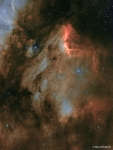 IC 5070: A Dusty Pelican in the Swan
19.11.2016
The recognizable profile of the Pelican Nebula soars nearly 2,000 light-years away in the high flying constellation Cygnus, the Swan. Also known as IC 5070, this interstellar cloud of gas and dust...
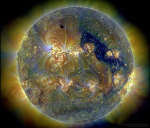 Venus and the Triply Ultraviolet Sun
4.02.2018
An unusual type of solar eclipse occurred in 2012. Usually it is the Earth's Moon that eclipses the Sun. That year, most unusually, the planet Venus took a turn. Like a solar eclipse by the Moon, the phase of Venus became a continually thinner crescent as Venus became increasingly better aligned with the Sun.
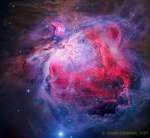 M42: Inside the Orion Nebula
30.10.2019
The Great Nebula in Orion, an immense, nearby starbirth region, is probably the most famous of all astronomical nebulas. Here, glowing gas surrounds hot young stars at the edge of an immense interstellar molecular cloud only 1500 light-years away.
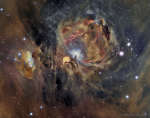 Orion Nebula in Oxygen, Hydrogen, and Sulfur
4.10.2020
Few astronomical sights excite the imagination like the nearby stellar nursery known as the Orion Nebula. The Nebula's glowing gas surrounds hot young stars at the edge of an immense interstellar molecular cloud.
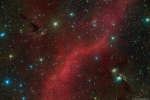 North of Orion s Belt
5.11.2020
Bright stars, interstellar clouds of dust and glowing nebulae fill this cosmic scene, a skyscape just north of Orion's belt. Close to the plane of our Milky Way Galaxy, the wide field view spans just under 5 degrees or about 10 full moons on the sky.
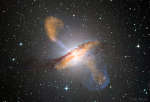 Jets from Unusual Galaxy Centaurus A
17.01.2021
The jets emanating from Centaurus A are over a million light years long. These jets of streaming plasma, expelled by a giant black hole in the center of this spiral galaxy, light up this composite image of Cen A. Exactly how the central black hole expels infalling matter remains unknown.
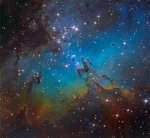 M16 Close Up
9.09.2021
A star cluster around 2 million years young surrounded by natal clouds of dust and glowing gas, M16 is also known as The Eagle Nebula. This beautifully detailed image of the region adopts the colorful Hubble palette and includes cosmic sculptures made famous in Hubble Space Telescope close-ups of the starforming complex.
 Northern Lights from the Stratosphere
18.01.2024
Northern lights shine in this night skyview from planet Earth's stratosphere, captured on January 15. The single, 5 second exposure was made with a hand-held camera on board an aircraft above Winnipeg, Canada. During the exposure, terrestrial lights below leave colorful trails along the direction of motion of the speeding aircraft.
 APOD: 2024 November 4 Б M42: The Great Nebula in Orion
4.11.2024
The Great Nebula in Orion, an immense, nearby starbirth region, is probably the most famous of all astronomical nebulas. Here, glowing gas surrounds hot young stars at the edge of an immense interstellar molecular cloud only 1500 light-years away.
|
January February March April May June July August September October |
|||||||||||||||||||||||||||||||||||||||||||||||||