
|
You entered: color
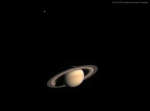 Cassini Approaches Saturn
10.04.2016
Cassini, a robot spacecraft launched in 1997 by NASA, became close enough in 2002 to resolve many rings and moons of its destination planet: Saturn. At that time, Cassini snapped several images during an engineering test. Several of those images were combined into the contrast-enhanced color composite featured here.
 M13: The Great Globular Cluster in Hercules
12.05.2017
In 1716, English astronomer Edmond Halley noted, "This is but a little Patch, but it shews itself to the naked Eye, when the Sky is serene and the Moon absent." Of course...
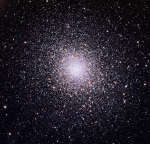 Messier 5
9.05.2019
"Beautiful Nebula discovered between the Balance [Libra] & the Serpent [Serpens] ..." begins the description of the 5th entry in 18th century astronomer Charles Messier's famous catalog of nebulae and star clusters. Though it appeared...
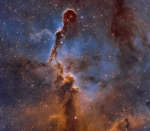 The Elephant s Trunk Nebula in Cepheus
16.08.2019
Like an illustration in a galactic Just So Story, the Elephant's Trunk Nebula winds through the emission nebula and young star cluster complex IC 1396, in the high and far off constellation of Cepheus. Also known as vdB 142, the cosmic elephant's trunk is over 20 light-years long.
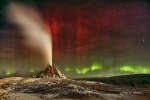 Aurora Over White Dome Geyser
20.02.2022
Sometimes both heaven and Earth erupt. Colorful auroras erupted unexpectedly a few years ago, with green aurora appearing near the horizon and brilliant bands of red aurora blooming high overhead. A bright Moon lit the foreground of this picturesque scene, while familiar stars could be seen far in the distance.
 NGC 2442: Galaxy in Volans
1.04.2023
Distorted galaxy NGC 2442 can be found in the southern constellation of the flying fish, (Piscis) Volans. Located about 50 million light-years away, the galaxy's two spiral arms extending from a pronounced central...
 APOD: 2025 January 7 Б A New Years Aurora and SAR Arc
7.01.2025
It was a new year, and the sky was doubly red. The new year meant that the Earth had returned to its usual place in its orbit on January 1, a place a few days before its closest approach to the Sun.
 Ares 3 Landing Site: The Martian Revisited
17.05.2025
This close-up from the Mars Reconnaissance Orbiter's HiRISE camera shows weathered craters and windblown deposits in southern Acidalia Planitia. A striking shade of blue in standard HiRISE image colors, to the human eye the area would probably look grey or a little reddish.
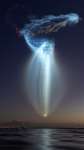 APOD: 2026 March 19 Б Launch Plume: SpaceX Jellyfish
19.03.2026
Even if you live with your head in the clouds, you wonБt find a jellyfish like this one very often. The featured image shows a SpaceX Falcon 9 rocket launch from Cape Canaveral in Florida on March 4.
 Valles Marineris Perspective from Mars Express
29.01.2004
Europe's Mars Express satellite has started returning detailed color images of the red planet. The first of the current armada to arrive at Mars, the orbiting satellite will photograph the entire Martian surface...
|
January February March April May June July August September October |
|||||||||||||||||||||||||||||||||||||||||||||||||