
|
You entered: color
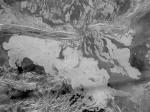 Lava Flows on Venus
23.03.2004
The hot surface of Venus shows clear signs of ancient lava flows. Evidence of this was bolstered by the robot spacecraft Magellan, which orbited Venus in the early 1990s. Using imaging radar, Magellan was able to peer beneath the thick perpetual clouds that cover Earth's closest planetary neighbor.
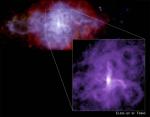 3C58: Pulsar Power
23.12.2004
Light from a star that exploded some ten thousand light-years away first reached our fair planet in the year 1181. Now known as supernova remnant 3C58, the region seen in this false-color image glows in x-rays, powered by a rapidly spinning neutron star or pulsar - the dense remains of the collapsed stellar core.
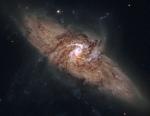 NGC 3314: When Galaxies Overlap
11.05.2000
Can this be a spiral galaxy? In fact, NGC 3314 consists of two large spiral galaxies which just happen to almost exactly line-up. The foreground spiral is viewed nearly face-on, its pinwheel shape defined by young bright star clusters.
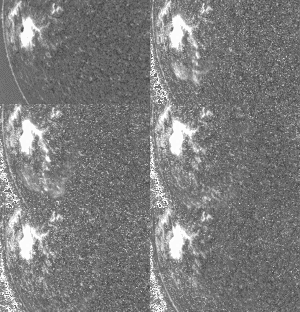 A Large Tsunami Shock Wave on the Sun
13.12.2006
Tsunami's this large don't happen on Earth. One week ago, a large solar flare from an Earth-sized sunspot produced a tsunami-type shock wave that was spectacular even for the Sun. Pictured above...
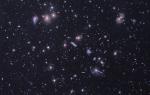 The Hercules Cluster of Galaxies
19.07.2007
These are galaxies of the Hercules Cluster, an archipelago of island universes a mere 500 million light-years away. Also known as Abell 2151, this cluster is loaded with gas and dust rich, star-forming spiral galaxies but has relatively few elliptical galaxies, which lack gas and dust and the associated newborn stars.
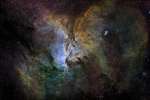 Shaping NGC 6188
2.05.2008
Dark shapes with bright edges winging their way through dusty NGC 6188 are tens of light-years long. The emission nebula is found near the edge of an otherwise dark large molecular cloud in the southern constellation Ara, about 4,000 light-years away.
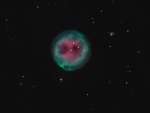 M97: The Owl Nebula
15.05.2009
The Owl Nebula is perched in the sky about 2,600 light-years away toward the bottom of the Big Dipper's bowl. Also cataloged as M97, the 97th object in Messier's well-known list, its round shape along with the placement of two large, dark "eyes" do suggest the face of a staring owl.
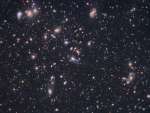 The Hercules Cluster of Galaxies
16.07.2009
These are galaxies of the Hercules Cluster, an archipelago of island universes a mere 500 million light-years away. Also known as Abell 2151, this cluster is loaded with gas and dust rich, star-forming spiral galaxies but has relatively few elliptical galaxies, which lack gas and dust and the associated newborn stars.
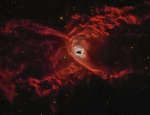 The Red Spider Planetary Nebula
29.10.2012
Oh what a tangled web a planetary nebula can weave. The Red Spider Planetary Nebula shows the complex structure that can result when a normal star ejects its outer gases and becomes a white dwarf star.
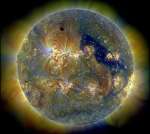 Venus and the Triply Ultraviolet Sun
20.08.2013
An unusual type of solar eclipse occurred last year. Usually it is the Earth's Moon that eclipses the Sun. Last June, most unusually, the planet Venus took a turn. Like a solar eclipse by the Moon, the phase of Venus became a continually thinner crescent as Venus became increasingly better aligned with the Sun.
|
January February March April May June July August September October |
|||||||||||||||||||||||||||||||||||||||||||||||||