
|
You entered: distance
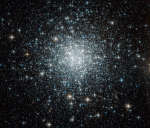 Globular Star Cluster NGC 6934
9.10.2010
Globlular star clusters roam the halo of our Milky Way Galaxy. Gravitationally bound, these spherical groupings of typically several hundred thousand stars are ancient, older than the stars of the galactic disk. In fact...
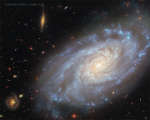 APOD: 2025 November 5 Б Spiral Galaxy NGC 3370 from Hubble
5.11.2025
Is this what our own Milky Way Galaxy looks like from far away? Similar in size and grand design to our home Galaxy (although without the central bar), spiral galaxy NGC 3370 lies about 100 million light-years away toward the constellation of the Lion (Leo).
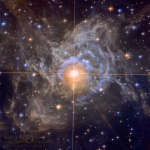 RS Puppis
17.05.2019
Pulsating RS Puppis, the brightest star in the image center, is some ten times more massive than our Sun and on average 15,000 times more luminous. In fact, RS Pup is a Cepheid...
 Aristarchus' Unbelievable Discoveries
14.09.1996
Here lived one of the greatest thinkers in human history. Aristarchus lived on the Greek island of Samos, a small island in the center of the above picture that can be identified with a good map.
 Aristarchus' Unbelievable Discoveries
8.11.1997
Here lived one of the greatest thinkers in human history. Aristarchus lived on the Greek island of Samos, a small island in the center of the above picture that can be identified with a good map.
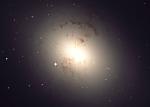 Unusual Giant Galaxy NGC 1316
16.08.2000
Can unusual giant galaxy NGC 1316 help calibrate the universe? Quite possibly -- if it turns out this atypical galaxy is composed of typical stars. NGC 1316, pictured above, is most obviously strange because...
 NGC 4603 and the Expanding Universe
27.05.1999
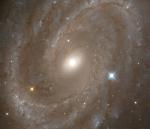
NGC 4603, a galaxy with majestic spiral arms and intricate dust lanes, is 108 million light-years away. Its distance has been accurately measured by astronomers using one of the fundamental yardsticks of the extragalactic distance scale - pulsating variable stars known as Cepheids.
 Echoes from RS Pup
12.02.2008
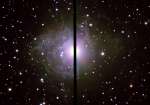
This dusty reflection nebula surrounds pulsating star RS Pup, some 10 times more massive than the Sun and on average 15,000 times more luminous. In fact, RS Pup is a Cepheid type variable...
 The Cepheids of M100
10.01.1996
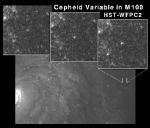
Can this blinking star tell us how fast the universe is expanding? Many astronomers also believe it may also tell us the age of the universe! The photographed "Cepheid variable" star in M100 brightens and dims over the course of days as its atmosphere expands and contracts.
 Nearby Cepheid Variable RS Pup
29.08.2018
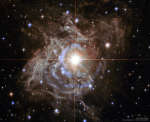
In the center is one of the most important stars on the sky. This is partly because, by coincidence, it is surrounded by a dazzling reflection nebula. Pulsating RS Puppis, the brightest star in the image center, is some ten times more massive than our Sun and on average 15,000 times more luminous.
|
January February March April May June July August September October |
|||||||||||||||||||||||||||||||||||||||||||||||||