
|
You entered: star
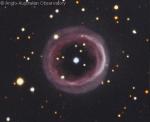 Shapley 1: An Annular Planetary Nebula
9.08.1998
What happens when a star runs out of nuclear fuel? The center condenses into a white dwarf while the outer atmospheric layers are expelled into space and appear as a planetary nebula. This particular planetary nebula, designated Shapley 1 after the famous astronomer Harlow Shapley, has a very apparent annular ring like structure.
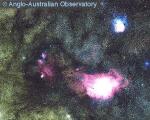 The Sky Towards Sagittarius
7.09.1998
A variety of stars and nebulae can be found towards the constellation of Sagittarius. Dense fields of stars laced with dark lanes of dust crowd this region only a few degrees from the center of our Galaxy.
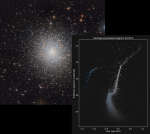 The Colors and Magnitudes of M13
13.06.2019
M13 is modestly recognized as the Great Globular Star Cluster in Hercules. A ball of stars numbering in the hundreds of thousands crowded into a region 150 light years across, it lies some 25,000 light-years away. The sharp, color picture of M13 at upper left is familiar to many telescopic imagers.
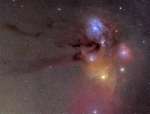 The Dark River to Antares
8.07.2009
Connecting the Pipe Nebula to the colorful regon near bright star Antares is a dark cloud dubbed the Dark River, flowing from the picture's left edge. Murky looking, the Dark River's appearance is caused by dust obscuring background starlight, although the dark nebula contains mostly hydrogen and molecular gas.
 Bright Jupiter in Taurus
27.11.2012
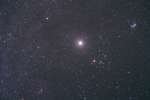
That bright star you've recently noticed rising just after sunset isn't a star at all. It's Jupiter, the solar system's ruling gas giant. Bright Jupiter is nearing its December 3rd opposition when it will stand in Taurus, opposite the Sun in planet Earth's sky.
 Blue Comet in the Hyades
18.01.2018
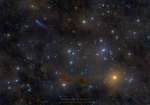
Stars of the Hyades cluster are scattered through this mosaic spanning over 5 degrees on the sky toward the constellation Taurus. Presently cruising through the Solar System, the remarkably blue comet C/2016 R2 PanSTARRS is placed in the wide field of view using image data from January 12.
 Saturn at Night
24.10.2025
Saturn is bright in Earth's night skies. Telescopic views of the outer gas giant planet and its beautiful rings often make it a star at star parties. But this stunning view of Saturn's rings and night side just isn't possible from telescopes in the vicinity of planet Earth.
 Double Cluster in Perseus
23.01.2014
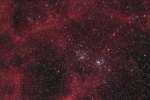
This lovely starfield spans some seven full moons (about 3.5 degrees) across the heroic northern constellation of Perseus. Just right of center it holds the famous pair of open or galactic star clusters, h and Chi Perseii.
 M46 Plus Two
17.04.2015
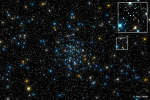
Galactic or open star clusters are young. These swarms of stars are born together near the plane of the Milky Way, but their numbers steadily dwindle as cluster members are ejected by galactic tides and gravitational interactions. In fact, this bright open cluster, known as M46, is around 300 million years young.
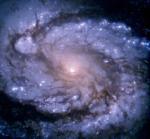 M100: A Grand Design
3.02.2001
Majestic on a truly cosmic scale, M100 is appropriately known as a Grand Design spiral galaxy. A large galaxy of over 100 billion or so stars with well defined spiral arms, it is similar to our own Milky Way.
|
January February March April May June July August September October |
|||||||||||||||||||||||||||||||||||||||||||||||||