
|
You entered: star
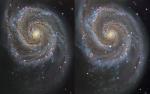 A Nearby Supernova in M51
19.07.2005
One of the nearest supernovas of recent years was discovered late last month in the bright nearby galaxy M51. It is visible on the right of the above before and after images of the picturesque spiral. Can you spot it?
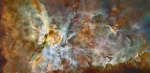 Carina Nebula Panorama from Hubble
24.05.2009
In one of the brightest parts of Milky Way lies a nebula where some of the oddest things occur. NGC 3372, known as the Great Nebula in Carina, is home to massive stars and changing nebula.
 Southern Geminids
18.12.2009
At least 34 meteors are included in this composite image as they rain through Australian skies during the annual Geminid Meteor shower. Dust particles strung out along the orbit of extinct comet Phaethon vaporize when they plow through planet Earth's atmosphere causing the impressive display.
 APOD: 2024 February 4 Б The Cone Nebula from Hubble
4.02.2024
Stars are forming in the gigantic dust pillar called the Cone Nebula. Cones, pillars, and majestic flowing shapes abound in stellar nurseries where natal clouds of gas and dust are buffeted by energetic winds from newborn stars. The Cone Nebula, a well-known example, lies within the bright galactic star-forming region NGC 2264.
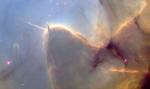 Trifid Pillars and Jets
28.12.2003
Dust pillars are like interstellar mountains. They survive because they are more dense than their surroundings, but they are being slowly eroded away by a hostile environment. Visible in the above picture...
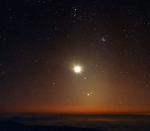 Planets Above The Clouds
4.05.2000
Clouds scatter the faint orange rays of the setting sun in the foreground of this breathtaking photograph from the summit of Mauna Kea, Hawaii. Taken on April 7th, this skyscape features a dramatic lunar and planetary alignment.
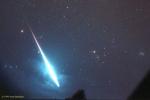 1999 Leonid Fireball
2.12.1999
Most Leonid meteoroids, the bits of comet debris which produce the annual Leonid meteor shower, range from a mere millimeter to a centimeter in diameter. Yet these cosmic grains of sand and gravel can put on quite a spectacular show. How can something so small generate so much light?
 The Cat's Eye Nebula
31.10.1999
Three thousand light-years away, a dying star throws off shells of glowing gas. This image from the Hubble Space Telescope reveals The Cat's Eye Nebula to be one of the most complex planetary nebulae known.
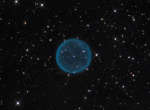 Spherical Planetary Nebula Abell 39
8.10.2012
Ghostly in appearance, Abell 39 is a remarkably simple, spherical nebula about five light-years across. Well within our own Milky Way galaxy, the cosmic sphere is roughly 7,000 light-years distant toward the constellation Hercules.
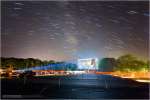 Night at the Drive In
20.09.2013
Colorful stars trail through this late summer, night skyscape from Cape Cod, Massachusetts. The picture was composed by stacking 12 consecutive 1 minute long digital camera exposures to follow the trails, a reflection of our fair planet's daily rotation.
|
January February March April May June July August September October |
|||||||||||||||||||||||||||||||||||||||||||||||||