
|
You entered: star
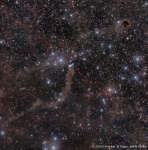 In Wolf s Cave
7.09.2019
The mysterious blue reflection nebula found in catalogs as VdB 152 or Ced 201 really is very faint. It lies at the tip of the long dark nebula Barnard 175 in a dusty complex that has also been called Wolf's Cave.
 APOD: 2023 September 4 Б Cygnus: Bubble and Crescent
4.09.2023
As stars die, they create clouds. Two stellar death clouds of gas and dust can be found toward the high-flying constellation of the Swan (Cygnus) as they drift through rich star fields in the plane of our Milky Way Galaxy.
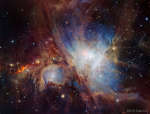 The Orion Nebula in Infrared from HAWK I
18.07.2016
The deepest infrared image of the Orion Nebula has uncovered a bonanza of previously unknown low-mass stars and -- quite possibly -- free floating planets. The picturesque nebula is best known in visible light where it shows a many bright stars and bright glowing gas.
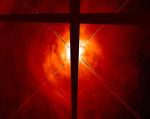 AB Aurigae: How To Make Planets
8.02.2003
This enhanced Hubble Space Telescope image shows in remarkable detail the inner portion of the disk of dust and gas surrounding the star AB Aurigae. Knots of material, visible here for the first time...
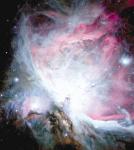 The Orion Nebula from CFHT
15.03.2004
Few astronomical sights excite the imagination like the nearby stellar nursery known as the Orion Nebula. The Nebula's glowing gas surrounds hot young stars at the edge of an immense interstellar molecular cloud only 1500 light-years away.
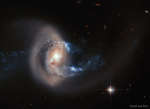 Galaxy NGC 7714 After Collision
9.06.2015
Is this galaxy jumping through a giant ring of stars? Probably not. Although the precise dynamics behind the featured image is yet unclear, what is clear is that the pictured galaxy, NGC 7714, has been stretched and distorted by a recent collision with a neighboring galaxy.
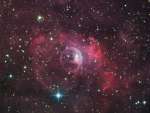 The Bubble Nebula
24.01.2009
Blown by the wind from a massive star, this interstellar apparition has a surprisingly familiar shape. Cataloged as NGC 7635, it is also known simply as The Bubble Nebula. This colorful telescopic image includes a long exposure through a hydrogen alpha filter to reveal details of the cosmic bubble and its environment.
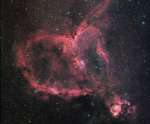 IC 1805: The Heart Nebula
14.02.2009
Sprawling across almost 200 light-years, emission nebula IC 1805 is a mix of glowing interstellar gas and dark dust clouds. Derived from its Valentine's-Day-approved shape, its nickname is the Heart Nebula. About 7,500 light-years away in the Perseus spiral arm of our galaxy, stars were born in IC 1805.
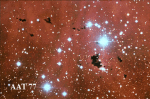 Dark Bok Globules in IC 2944
6.10.1995
The dark spots in the above picture are not photographic defects but an unusual type of interstellar cloud known as a Bok globule. Bok globules, named after astronomer Bart Bok who studied them extensively, are small dark clouds made of gas and dust that are typically condensing to form a star or stars.
 Downtown Auriga
13.02.2014
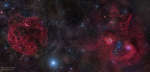
Rich in star clusters and nebulae, the ancient constellation of Auriga, the Charioteer, rides high in northern winter night skies. Spanning nearly 24 full moons (12 degrees) on the sky, this deep telescopic mosaic view recorded in January shows off some of Auriga's most popular sights for cosmic tourists.
|
January February March April May June July August September October |
|||||||||||||||||||||||||||||||||||||||||||||||||