
|
You entered: star
 APOD: 2025 January 27 Б Pleiades over Half Dome
27.01.2025
Stars come in bunches. The most famous bunch of stars on the sky is the Pleiades, a bright cluster that can be easily seen with the unaided eye. The Pleiades lies only about 450 light years away, formed about 100 million years ago, and will likely last about another 250 million years.
 A Planet For Gliese 876
26.06.1998
Centered in this unremarkable, 1/4 degree wide patch of sky in the constellation Aquarius is the star Gliese 876. Gliese 876 is smaller than the Sun, only about 1/3 as massive, and too faint to be seen without a telescope. But it is known to be one of the nearest stars, only 15 light-years distant.
 M39: Open Cluster in Cygnus
31.03.2004
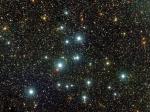
Lying just at the limit of human perception is a picturesque starfield containing one of the larger open clusters on the northern sky. Spanning an angle larger than the Moon, M39's relatively few stars lie only about 800 light years distant toward the constellation of Cygnus.
 A Dust Cloud in NGC 281
20.04.2006
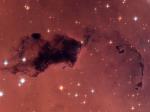
Stars themselves can create huge and intricate dust sculptures from the dense and dark molecular clouds from which they are born. The tools the stars use to carve their detailed works are high energy light and fast stellar winds.
 M31: The Andromeda Galaxy
10.05.2009
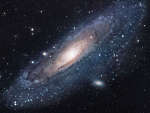
Andromeda is the nearest major galaxy to our own Milky Way Galaxy. Our Galaxy is thought to look much like Andromeda. Together these two galaxies dominate the Local Group of galaxies. The diffuse light from Andromeda is caused by the hundreds of billions of stars that compose it.
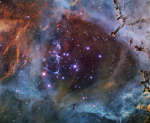 In the Heart of the Rosette Nebula
11.03.2014
In the heart of the Rosette Nebula lies a bright open cluster of stars that lights up the nebula. The stars of NGC 2244 formed from the surrounding gas only a few million years ago.
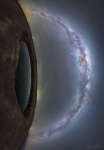 Eye on the Milky Way
21.04.2020
Have you ever had stars in your eyes? It appears that the eye on the left does, and moreover it appears to be gazing at even more stars. The featured 27-frame mosaic was taken last July from Ojas de Salar in the Atacama Desert of Chile.
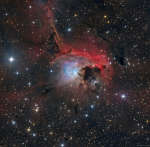 NGC 2626 along the Vela Molecular Ridge
4.02.2023
Centered in this colorful cosmic canvas, NGC 2626 is a beautiful, bright, blue reflection nebula in the southern Milky Way. Next to an obscuring dust cloud and surrounded by reddish hydrogen emission from large H II region RCW 27 it lies within a complex of dusty molecular clouds known as the Vela Molecular Ridge.
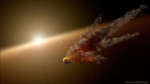 Unexplained Dimmings in KIC 8462852
13.06.2016
Why does star KIC 8462852 keep wavering? Nobody knows. A star somewhat similar to our Sun, KIC 8462852 was one of many distant stars being monitored by NASA's robotic Kepler satellite to see if it had planets.
 NGC 1999: South of Orion
30.01.2006
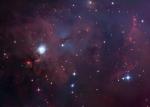
South of the large star-forming region known as the Orion Nebula, lies bright blue reflection nebula NGC 1999. The nebula is marked with a dark inverted T-shape at the lower left in a broad cosmic vista that spans over 10 light-years.
|
January February March April May June July August September October |
|||||||||||||||||||||||||||||||||||||||||||||||||