
|
You entered: light
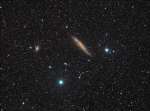 NGC 4945 in Centaurus
9.01.2009
Large, dusty, spiral galaxy NGC 4945 is seen edge-on near the center of this rich telescopic image. The field of view spans nearly 2 degrees, or about 4 times the width of the Full Moon, toward the expansive southern constellation Centaurus.
 Seaside Moon Mirage
20.06.2009
This surprising view of the Full Moon rising on June 7 was captured with a telephoto lens from a seaside balcony near Nice, France. The orange Moon's dark markings and odd shape put the photographer in mind of an alien creature's face staring down at the passing ship.
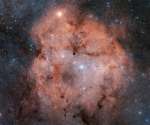 IC 1396: Emission Nebula in Cepheus
5.08.2012
Stunning emission nebula IC 1396 mixes glowing cosmic gas and dark dust clouds in the high and far off constellation of Cepheus. Energized by the bright, bluish central star seen here, this star forming region sprawls across hundreds of light-years -- spanning over three degrees on the sky while nearly 3,000 light-years from planet Earth.
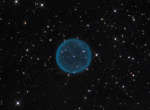 Spherical Planetary Nebula Abell 39
8.10.2012
Ghostly in appearance, Abell 39 is a remarkably simple, spherical nebula about five light-years across. Well within our own Milky Way galaxy, the cosmic sphere is roughly 7,000 light-years distant toward the constellation Hercules.
 Millions of Stars in Omega Centauri
29.05.2014
Globular star cluster Omega Centauri, also known as NGC 5139, is some 15,000 light-years away. The cluster is packed with about 10 million stars much older than the Sun within a volume about...
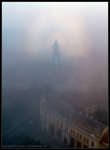 The Spectre of Veszprem
23.08.2014
The city of Veszprem, Hungary was only briefly haunted by this mysterious spectre. On the morning of August 11, its monstrous form hovered in the mist above municipal buildings near the town center.
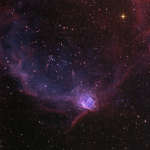 NGC 602 in the Flying Lizard Nebula
6.03.2015
Near the outskirts of the Small Magellanic Cloud, a satellite galaxy some 200 thousand light-years distant, lies 5 million year young star cluster NGC 602. Surrounded by natal gas and dust, NGC 602 is just below center in this telescopic field of view with the angular size of the Full Moon on the sky.
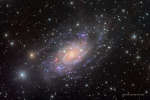 NGC 2403 in Camelopardalis
19.02.2016
Magnificent island universe NGC 2403 stands within the boundaries of the long-necked constellation Camelopardalis. Some 10 million light-years distant and about 50,000 light-years across, the spiral galaxy also seems to have more than its fair share of giant star forming HII regions, marked by the telltale reddish glow of atomic hydrogen gas.
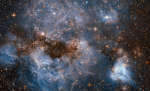 N159 in the Large Magellanic Cloud
28.01.2017
Over 150 light-years across, this cosmic maelstrom of gas and dust is not too far away. It lies south of the Tarantula Nebula in our satellite galaxy the Large Magellanic Cloud a mere 180,000 light-years distant. Massive stars have formed within.
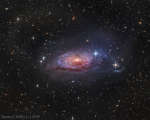 Messier 63: The Sunflower Galaxy
6.06.2019
A bright spiral galaxy of the northern sky, Messier 63 is about 25 million light-years distant in the loyal constellation Canes Venatici. Also cataloged as NGC 5055, the majestic island universe is nearly 100,000 light-years across. That's about the size of our own Milky Way Galaxy.
|
January February March April May June July August September October |
|||||||||||||||||||||||||||||||||||||||||||||||||