
|
You entered: light
 A Slice of the Universe with 2dF
14.06.2000
What can 100,000 galaxies tell you? Perhaps the structure and composition of the universe. Astronomers using the Two Degree Field (2dF) spectrograph on the Anglo-Australian Telescope (AAT) in Australia have now measured the redshifts of over 100,000 galaxies in a thin ribbon of the sky.
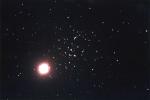 Jupiter in the Hive
3.04.2003
If you can find planet Jupiter in tonight's sky, then you can also find M44, popularly known as the Beehive star cluster. In fact, with a pair of binoculars most casual skygazers should find it easy to zero in on this celestial scene.
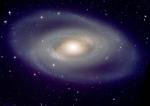 Spiral Galaxy NGC 1350
6.10.2005
This gorgeous island universe lies about 85 million light-years distant in the southern constellation Fornax. Inhabited by young blue star clusters, the spiral arms of NGC 1350 seem to join in a circle around the galaxy's large, bright nucleus - giving the galaxy the appearance of a limpid cosmic eye.
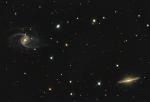 APOD: 2006 September 29- NGC 5905 and 5908
29.09.2006
These two beautiful galaxies, NGC 5905 (left) and NGC 5908 lie about 140 million light-years distant in the northern constellation Draco. Separated by about 500,000 light-years, the pair are actually both spiral galaxies and nicely illustrate the striking contrasts in appearance possible when viewing spirals from different perspectives.
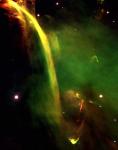 Arcs and Jets in Herbig Haro 34
28.11.1999
Some features of HH-34 are understood -- some are not. At the core of Herbig-Haro 34 lies a seemingly typical young star. This star, though, somehow ejects energetic "bullets" of high-energy particles, appearing as red streaks toward the lower right of the this image.
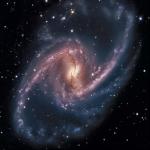 NGC 1365: Majestic Island Universe
28.03.2007
Barred spiral galaxy NGC 1365 is truly a majestic island universe some 200,000 light-years across. Located a mere 60 million light-years away toward the chemical constellation Fornax, NGC 1365 is a dominant member of the well-studied Fornax galaxy cluster.
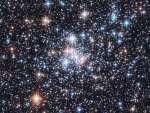 Open Cluster NGC 290: A Stellar Jewel Box
3.08.2008
Jewels don't shine this bright -- only stars do. Like gems in a jewel box, though, the stars of open cluster NGC 290 glitter in a beautiful display of brightness and color. The photogenic cluster, pictured above, was captured recently by the orbiting Hubble Space Telescope.
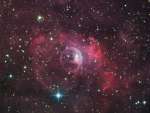 The Bubble Nebula
23.01.2009
Blown by the wind from a massive star, this interstellar apparition has a surprisingly familiar shape. Cataloged as NGC 7635, it is also known simply as The Bubble Nebula. This colorful telescopic image includes a long exposure through a hydrogen alpha filter to reveal details of the cosmic bubble and its environment.
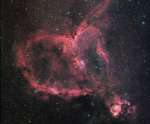 IC 1805: The Heart Nebula
13.02.2009
Sprawling across almost 200 light-years, emission nebula IC 1805 is a mix of glowing interstellar gas and dark dust clouds. Derived from its Valentine's-Day-approved shape, its nickname is the Heart Nebula. About 7,500 light-years away in the Perseus spiral arm of our galaxy, stars were born in IC 1805.
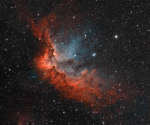 NGC 7380: The Wizard Nebula
2.11.2011
What powers are being wielded in the Wizard Nebula? Gravitation strong enough to form stars, and stellar winds and radiations powerful enough to create and dissolve towers of gas. Located only 8,000 light years away, the Wizard nebula, pictured above, surrounds developing open star cluster NGC 7380.
|
January February March April May June July August September October |
|||||||||||||||||||||||||||||||||||||||||||||||||