
|
You entered: light
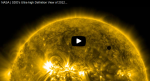 A Venus Transit Music Video from SDO
11.06.2012
What's that black dot moving across the Sun? Venus. Possibly the clearest view of Venus crossing in front of the Sun last week was from Earth orbit. The Solar Dynamics Observatory obtained an uninterrupted vista recording it not only in optical light but also in bands of ultraviolet light.
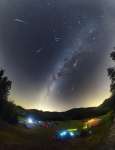 Night of the Perseids
10.08.2017
This weekend, meteors will rain down near the peak of the annual Perseid Meteor Shower. Normally bright and colorful, the Perseid shower meteors are produced by dust swept up by planet Earth from the orbit of Comet Swift-Tuttle. They streak from a radiant in Perseus, above the horizon in clear predawn skies.
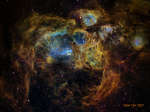 NGC 6357: The Lobster Nebula
26.12.2018
Why is the Lobster Nebula forming some of the most massive stars known? No one is yet sure. Cataloged as NGC 6357, the Lobster Nebula houses the open star cluster Pismis 24 near its center -- a home to unusually bright and massive stars.
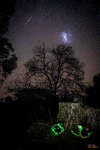 Ghost Fungus to Magellanic Cloud
23.05.2020
Stars shine and satellites glint in this clear, dark, night sky over Wannon Falls Reserve, South West Victoria, Australia. In fact the fuzzy, faint apparition above the tree tops is the only cloud visible, also known as the Large Magellanic Cloud, satellite galaxy of our own Milky Way.
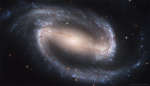 Barred Spiral Galaxy NGC 1300
16.10.2022
Across the center of this spiral galaxy is a bar. And at the center of this bar is smaller spiral. And at the center of that spiralбis a supermassiveбblack hole.б This all happens...
 NGC 206 and the Star Clouds of Andromeda
12.04.2023
The large stellar association cataloged as NGC 206 is nestled within the dusty arms of the neighboring Andromeda galaxy along with the galaxy's pinkish star-forming regions. Also known as M31, the spiral galaxy is a mere 2.5 million light-years away.
 APOD: 2023 November 13 Б Andromeda over the Alps
13.11.2023
Have you ever seen the Andromeda galaxy? Although M31 appears as a faint and fuzzy blob to the unaided eye, the light you see will be over two million years old, making it likely the oldest light you ever will see directly.
 Globular Star Cluster 47 Tuc
8.02.2024
Globular star cluster 47 Tucanae is a jewel of the southern sky. Also known as NGC 104, it roams the halo of our Milky Way Galaxy along with some 200 other globular star clusters. The second brightest globular cluster (after Omega Centauri) as seen from planet Earth, 47 Tuc lies about 13,000 light-years away.
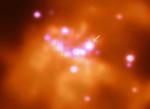 M82 s Middle Mass Black Hole
14.09.2000
Black holes are probably the most bizarre creatures in the modern astronomical zoo. And after years of pondering black holes as either stellar mass objects seen in binary star systems or enormous supermassive black holes at the centers of galaxies, astronomers now have strong evidence
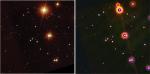 GRB 060218: A Mysterious Transient
27.02.2006
What is it? Something is happening in a small portion of the sky toward the constellation of Aries and telescopes around the globe are tracking an unusual transient there as it changes day by day. No one is sure what it will do next.
|
January February March April May June July August September October |
|||||||||||||||||||||||||||||||||||||||||||||||||