
|
You entered: light
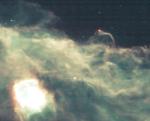 Infrared Horsehead
24.02.2001
This famous cosmic dust cloud was imaged in infrared light by the European Space Agency's Infrared Space Observatory (ISO) satellite. The false-color picture shows the bright infrared emission from dust and molecular gas in part of the Orion star forming region surrounding the Horsehead Nebula.
 Earth's Plasmasphere
31.01.2001
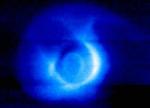
Our Earth is surrounded by plasma. The overall shape that this ionized gas plasmasphere takes was discovered last year by NASA's robot IMAGE spacecraft, and shown in the recently released above image in ultraviolet light.
 The Lagoon Nebula in Three Colors
20.08.2001
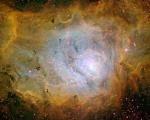
The bright Lagoon Nebula is home to a diverse array of astronomical objects. Particularly interesting sources include a bright open cluster of stars and several energetic star-forming regions. When viewed by eye, cluster light...
 The Lagoon Nebula in Three Colors
6.10.2002
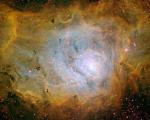
The bright Lagoon Nebula is home to a diverse array of astronomical objects. Particularly interesting sources include a bright open cluster of stars and several energetic star-forming regions. When viewed by eye, cluster light...
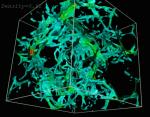 The Lyman Alpha Forest
26.01.2003
We live in a forest. Strewn throughout the universe are "trees" of hydrogen gas that absorb light from distant objects. These gas clouds leave numerous absorption lines in a distant quasar's spectra, together called the Lyman-alpha forest.
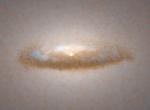 The Doomed Dust Disk of NGC 7052
22.06.1998
What created the dust disk in the center of NGC 7052, and what keeps it spinning? Although the disk might appear as a relatively tame "hubcap in space", the unusual center of elliptical galaxy NGC 7052 is probably the remnant of a titanic collision between galaxies.
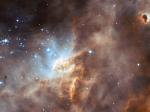 N11B: Star Cloud of the LMC
7.07.2004
Massive stars, abrasive winds, mountains of dust, and energetic light sculpt one of the largest and most picturesque regions of star formation in the Local Group of Galaxies. Known as N11, the region...
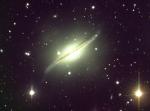 Warped Spiral Galaxy ESO510 13
12.05.1999
How did spiral galaxy ESO510-13 get bent out-of-shape? The disks of many spirals are thin and flat, but not solid. Spiral disks are loose conglomerations of billions of stars and diffuse gas all gravitationally orbiting a galaxy center.
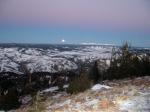 Shadow Set
4.02.2006
A nearly full Moon and planet Earth's shadow set together in this scene captured on January 13th from snowy Mt. Jelm, home of the Wyoming Infrared Observatory. For early morning risers (and late...
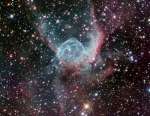 Thor s Emerald Helmet
17.01.2008
This helmet-shaped cosmic cloud with wing-like appendages is popularly called Thor's Helmet. Heroically sized even for a Norse god, Thor's Helmet is about 30 light-years across. In fact, the helmet is actually...
|
January February March April May June July August September October |
|||||||||||||||||||||||||||||||||||||||||||||||||