
|
You entered: light
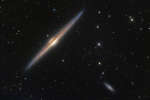 NGC 4565: Galaxy on Edge
15.10.2011
Magnificent spiral galaxy NGC 4565 is viewed edge-on from planet Earth. Also known as the Needle Galaxy for its narrow profile, bright NGC 4565 is a stop on many telescopic tours of the northern sky, in the faint but well-groomed constellation Coma Berenices.
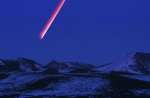 Red Moon Rising
16.12.2011
This surreal, wintry scene is a composite picture recorded on December 10 as the Moon rose behind the Zagros Mountains of Iran. A total lunar eclipse was already in progress. The image combines nearly 500 successive frames taken over 1.5 hours beginning in twilight as the eclipsed Moon steadily climbed above the rugged landscape.
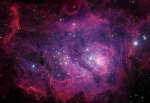 The Wide and Deep Lagoon
8.09.2016
Ridges of glowing interstellar gas and dark dust clouds inhabit the turbulent, cosmic depths of the Lagoon Nebula. Also known as M8, the bright star forming region is about 5,000 light-years distant.
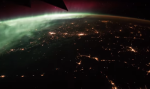 Flying over the Earth at Night II
11.03.2018
What would it be like to orbit the Earth? The International Space Station (ISS) does this every 90 minutes, and sometimes the astronauts on board take image sequences that are made into videos. The featured time-lapse video shows many visual spectacles of the dark Earth below.
 Red Planet Red Moon and Mars
8.08.2018
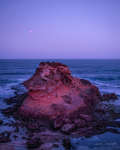
Mars is also known as The Red Planet, often seen with a reddish tinge in dark night skies. Mars shines brightly at the upper left of this gorgeous morning twilight view from Mornington Peninsula, Victoria, Australia, but the Moon and planet Earth look redder still. Taken on July 27, the totally eclipsed Moon is setting.
 M82: Starburst Galaxy with a Superwind
8.07.2021
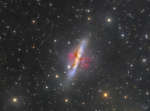
M82 is a starburst galaxy with a superwind. In fact, through ensuing supernova explosions and powerful winds from massive stars, the burst of star formation in M82 is driving a prodigious outflow. Evidence for the superwind from the galaxy's central regions is clear in sharp telescopic snapshot.
 NGC 604: Giant Stellar Nursery
24.04.2024
Located some 3 million light-years away in the arms of nearby spiral galaxy M33, giant stellar nursery NGC 604 is about 1,300 light-years across. That's nearly 100 times the size of the Milky Way's Orion Nebula, the closest large star forming region to planet Earth.
 X-Rays From Sirius B
6.10.2000
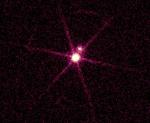
In visible light Sirius A (Alpha Canis Majoris) is the brightest star in the night sky, a closely watched celestial beacon throughout recorded history. Part of a binary star system only 8 light-years away, it was known in modern times to have a small companion star, Sirius B.
 The Hydrogen Clouds of M33
2.10.2019
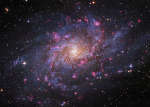
Gorgeous spiral galaxy M33 seems to have more than its fair share of glowing hydrogen gas. A prominent member of the local group of galaxies, M33 is also known as the Triangulum Galaxy and lies a mere 3 million light-years away.
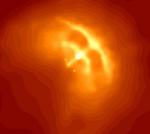 Vela Pulsar: Neutron Star-Ring-Jet
9.06.2000
This stunning image from the orbiting Chandra X-ray Observatory is centered on the Vela pulsar -- the collapsed stellar core within the Vela supernova remnant some 800 light-years distant. The Vela pulsar is a neutron star. More massive than the Sun, it has the
|
January February March April May June July August September October |
|||||||||||||||||||||||||||||||||||||||||||||||||