
|
You entered: light
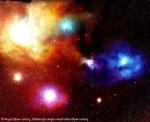 Antares and Rho Ophiuchi
21.05.2000
Why is the sky near Antares and Rho Ophiuchi so colorful? The colors result from a mixture of objects and processes. Fine dust illuminated from the front by starlight produces blue reflection nebulae. Gaseous clouds whose atoms are excited by ultraviolet starlight produce reddish emission nebulae. Backlit dust clouds block starlight and so appear dark.
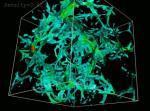 The Lyman Alpha Forest
24.02.1998
We live in a forest. Strewn throughout the universe are "trees" of hydrogen gas that absorb light from distant objects. These gas clouds leave numerous absorption lines in a distant quasar's spectra, together called the Lyman-alpha forest.
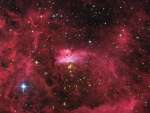 Massive Stars in NGC 6357
9.10.2008
Massive Stars lie within NGC 6357, an expansive emission nebula complex some 8,000 light-years away in the tail of the constellation Scorpius. In fact, positioned just below center in this close-up view...
 Double Cluster in Perseus
3.01.2009
Some 7,000 light-years away, this pair of open or galactic star clusters is an easy binocular target, a lovely starfield in the northern constellation Perseus. Also visible to the unaided eye from dark sky areas, it was cataloged in 130 BC by Greek astronomer Hipparchus.
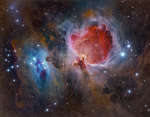 Great Orion Nebulae
13.09.2011
The Great Nebula in Orion, also known as M42, is one of the most famous nebulas in the sky. The star forming region's glowing gas clouds and hot young stars...
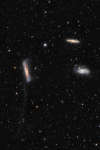 The Tidal Tail of NGC 3628
6.07.2012
A mere 30 million light-years away, large spiral galaxy NGC 3628 (center left) shares its neighborhood in the local Universe with two other large spirals, in a magnificent grouping otherwise known as the Leo Triplet.
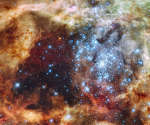 Star Cluster R136 Bursts Out
29.07.2012
In the center of star-forming region 30 Doradus lies a huge cluster of the largest, hottest, most massive stars known. These stars, known collectively as star cluster R136, were captured above in visible light by the newly installed Wide Field Camera peering though the recently refurbished Hubble Space Telescope.
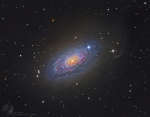 Messier 63: The Sunflower Galaxy
13.03.2014
A bright spiral galaxy of the northern sky, Messier 63 is about 25 million light-years distant in the loyal constellation Canes Venatici. Also cataloged as NGC 5055, the majestic island universe is nearly 100,000 light-years across. That's about the size of our own Milky Way Galaxy.
 Colorful Clouds Near Rho Ophiuchi
6.07.2015
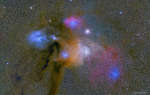
Why is the sky near Antares and Rho Ophiuchi so colorful? The colors result from a mixture of objects and processes. Fine dust illuminated from the front by starlight produces blue reflection nebulae. Gaseous clouds whose atoms are excited by ultraviolet starlight produce reddish emission nebulae. Backlit dust clouds block starlight and so appear dark.
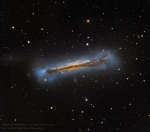 NGC 3682: Sideways Spiral Galaxy
5.09.2018
What do spiral galaxies look like sideways? Featured is a sharp telescopic view of a magnificent edge-on spiral galaxy NGC 3628, a puffy galactic disk divided by dark dust lanes. Of course, this deep galactic portrait puts some astronomers in mind of its popular moniker, The Hamburger Galaxy.
|
January February March April May June July August September October |
|||||||||||||||||||||||||||||||||||||||||||||||||