
|
You entered: space
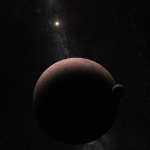 Moon over Makemake
30.04.2016
Makemake, second brightest dwarf planet of the Kuiper belt, has a moon. Nicknamed MK2, Makemake's moon reflects sunlight with a charcoal-dark surface, about 1,300 times fainter than its parent body. Still...
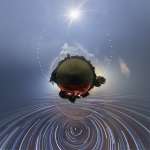 Little Planet Astro Camp
2.09.2016
Day and night on this little planet look a lot like day and night on planet Earth. In fact, the images used to construct the little planet projection, a digitally warped and stitched mosaic covering 360x180 degrees, were taken during day and night near Tarján, Hungary, planet Earth.
 Fermi Science Playoffs
8.06.2018
NASA's Fermi Gamma-ray Space Telescope was launched into orbit on June 11th, 2008. Its instruments detect gamma-rays -- light that is thousands to hundreds of billions of times more energetic than what we see with our eyes.
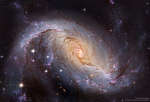 NGC 1672: Barred Spiral Galaxy from Hubble
9.10.2018
Many spiral galaxies have bars across their centers. Even our own Milky Way Galaxy is thought to have a modest central bar. Prominently barred spiral galaxy NGC 1672, featured here, was captured in spectacular detail in an image taken by the orbiting Hubble Space Telescope.
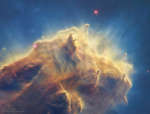 Star Formation in the Eagle Nebula
14.03.2022
Where do stars form? One place, star forming regions known as "EGGs", are being uncovered at the end of this giant pillar of gas and dust in the Eagle Nebula (M16). Short for evaporating gaseous globules, EGGs are dense regions of mostly molecular hydrogen gas that fragment and gravitationally collapse to form stars.
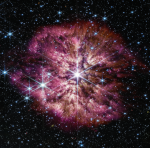 Wolf Rayet 124
18.03.2023
Driven by powerful stellar winds, expanding shrouds of gas and dust frame hot, luminous star Wolf-Rayet 124 in this sharp infrared view. The eye-catching 6-spike star pattern is characteristic of stellar images made with the 18 hexagonal mirrors of the James Webb Space Telescope.
 Back from Bennu
29.09.2023
Back from asteroid 101955 Bennu, a 110-pound, 31-inch wide sample return capsule rests in a desert on planet Earth in this photo, taken at the Department of Defense Utah Test and Training Range near Salt Lake City last Sunday, September 24.
 APOD: 2025 August 18 Б NGC 1309: A Useful Spiral Galaxy
18.08.2025
This galaxy is not only pretty -- it's useful. A gorgeous spiral some 100 million light-years distant, NGC 1309 lies on the banks of the constellation of the River (Eridanus). NGC 1309 spans about 30,000 light-years, making it about one third the size of our larger Milky Way galaxy.
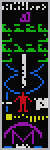 APOD: 2026 March 29 Б A Message from Earth
29.03.2026
What are these Earthlings trying to tell us? The featured message was broadcast from Earth towards the globular star cluster M13 in 1974. During the dedication of an upgrade to the Arecibo Observatory - then the largest single radio telescope in the world - a string of 1's and 0's representing the diagram was sent.
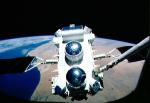 The Compton Gamma Ray Observatory
16.01.2000
The Compton Gamma Ray Observatory (CGRO) was the most massive instrument ever launched by a NASA Space Shuttle in 1991 and continues to revolutionize gamma-ray astronomy. Before Compton loses more stabilizing gyroscopes, NASA is considering firing onboard rockets to bring it on a controlled reentry into the ocean.
|
January February March April May June July August September October |
|||||||||||||||||||||||||||||||||||||||||||||||||