
|
You entered: space
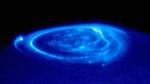 A Close Up of Aurora on Jupiter
19.12.2000
Jupiter has aurorae. Like Earth, the magnetic field of the gas giant funnels charged particles released from the Sun onto the poles. As these particles strike the atmosphere, electrons are temporarily knocked away from existing gas molecules. Electric force attracts these electrons back. As the electrons recombine to remake neutral molecules, auroral light is emitted.
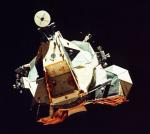 Apollo 17's Moonship
6.01.2001
Awkward and angular looking, Apollo 17's lunar module Challenger was designed for flight in the vacuum of space. This sharp picture from the command module America, shows Challenger's ascent stage in lunar orbit.
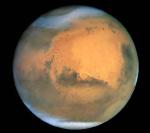 Mars from Earth
18.07.2001
Last month, Mars and Earth were right next to each other in their orbits. Formally called opposition, the event was highlighted by a very bright Mars for skywatchers and a good photo opportunity for the Hubble Space Telescope. Above, Hubble snapped the highest resolution picture of Mars ever obtained from the Earth.
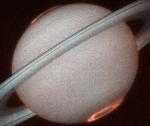 Saturnian Aurora
23.12.2001
the second largest planet in the Solar System, Saturn's Rings are one of the most spectacular sights for earthbound telescopes. This image from the orbiting Hubble Space Telescope's STIS instrument, offers a striking view of another kind of ring around Saturn - pole encircling rings of ultraviolet aurora.
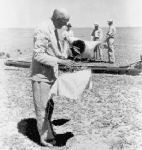 Rockets and Robert Goddard
16.09.1995
Robert H. Goddard, one of the founding fathers of modern rocketry, was born in Worcester Massachusetts in 1882. As a 16 year old, Goddard read H.G. Wells' science fiction classic "War Of The Worlds" and dreamed of spaceflight. By 1926 he had designed, built, and launched the world's first liquid fuel rocket.
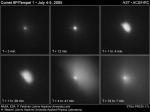 Deep Impact on Comet Tempel 1 from Hubble
18.07.2005
It was a human-made event visible across the Solar System. At the direction of terrestrial scientists, a refrigerator-sized probe from the Deep Impact mission struck Comet Tempel 1 on July 4 at over 35,000 kilometers per hour.
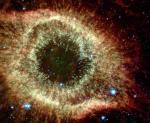 Infrared Helix
12.01.2006
Over six hundred light years from Earth, in the constellation Aquarius, a sun-like star is dying. Its last few thousand years have produced the Helix Nebula (NGC 7293), a well studied and nearby example of a Planetary Nebula, typical of this final phase of stellar evolution.
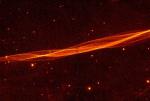 Filaments In The Cygnus Loop
26.04.2000
Subtle and delicate in appearance, these are filaments of shocked interstellar gas -- part of the expanding blast wave from a violent stellar explosion. Recorded in November 1997 with the Wide Field and Planetary Camera 2 onboard the Hubble Space Telescope, the picture is a closeup of a supernova remnant known as the Cygnus Loop.
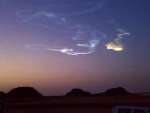 On the Trail of 2008 TC3
8.11.2008
On October 7, the early dawn over northern Sudan revealed this twisted, high altitude trail. Captured in a video frame, the long-lasting persistent train is from the impact of a small asteroid cataloged as 2008 TC3.
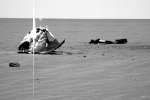 Metal on the Plains of Mars
31.07.2011
What has the Opportunity rover found on Mars? While traversing a vast empty plain in 2005 in Meridiani Planum, one of Earth's rolling robots on Mars found a surprise when visiting the location of its own metallic heat shield discarded last year during descent.
|
January February March April May June July August September October |
|||||||||||||||||||||||||||||||||||||||||||||||||