
|
You entered: space
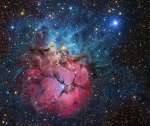 A Beautiful Trifid
13.05.2011
The beautiful Trifid Nebula is a cosmic study in colorful contrasts. Also known as M20, it lies about 5,000 light-years away toward the nebula rich constellation Sagittarius. A star forming region...
 Earth Rotating Under Very Large Telescopes
1.06.2011
Why is the Earth moving in the above video? Most time lapse videos of the night sky show the stars and sky moving above a steady Earth. Here, however, the frames have been digitally rotated so that it is the stars that stay (approximately) steady, and the Earth that moves beneath them.
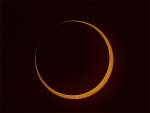 Cape York Annular Eclipse
11.05.2013
This week the shadow of the New Moon fell on planet Earth, crossing Queensland's Cape York in northern Australia ... for the second time in six months. On the morning...
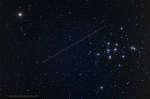 Close Encounter with M44
28.01.2015
On Monday, January 26, well-tracked asteroid 2004 BL86 made its closest approach, a mere 1.2 million kilometers from our fair planet. That's about 3.1 times the Earth-Moon distance or 4 light-seconds away. Moving...
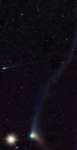 Comets and Bright Star
6.01.2016
This timely, telescopic, two panel mosaic spans about 10 full moons across planet Earth's predawn skies. Recorded as the year began from Tenerife, Canary Islands, near the top of the frame are the faint coma and tail of Comet Borrelly (P/19).
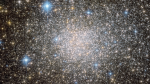 Zooming in on Star Cluster Terzan 5
21.09.2016
Globular clusters once ruled the Milky Way. Back in the old days, back when our Galaxy first formed, perhaps thousands of globular clusters roamed our Galaxy. Today, there are less than 200 left. Over the eons, many globular clusters were destroyed by repeated fateful encounters with each other or the Galactic center.
 Mars Opposition
27.07.2018
Look opposite the Sun in the sky tonight and you'll see Mars at its brightest. Also within days of its closest approach Mars rises at sunset, near its brightest and best for telescopic observers too, except for the dust storm still blanketing the Red Planet.
 APOD: 2023 June 6 Б Star Eats Planet
6.06.2023
ItБs the end of a world as we know it. Specifically, the Sun-like star ZTF SLRN-2020 was seen eating one of its own planets. Although many a planet eventually dies by spiraling into their central star, the 2020 event, involving a Jupiter-like planet, was the first time it was seen directly.
 APOD: 2023 September 19 Б HH 211: Jets from a Forming Star
19.09.2023
Do stars always create jets as they form? No one is sure. As a gas cloud gravitationally contracts, it forms a disk that can spin too fast to continue contracting into a protostar. Theorists hypothesize that this spin can be reduced by expelling jets.
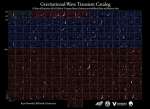 APOD: 2026 March 26 Б
26.03.2026
What is the sound of two black holes merging in deep space? Sound waves don't propagate in vacuum, but gravitational waves do. In 2015 we were able to "hear" them for the first time and confirm one of Albert Einstein's theoretical predictions.
|
January February March April May June July August September October |
|||||||||||||||||||||||||||||||||||||||||||||||||