
|
You entered: color
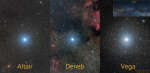 Stars of a Summer Triangle
27.06.2015
Rising at the start of a northern summer's night, these three bright stars form the familiar asterism known as the Summer Triangle. Altair, Deneb, and Vega are the alpha stars of their respective constellations, Aquila, Cygnus, and Lyra, nestled near the Milky Way.
 Perijove Passage
3.06.2017
On May 19, the Juno spacecraft once again swung by Jupiter in its looping 53 day orbit around the Solar System's ruling gas gaint. Beginning at the top, this vertical 14 frame sequence of enhanced-color JunoCam images follows the spacecraft's rapidly changing perspective during its two hour passage.
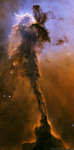 The Fairy of Eagle Nebula
2.12.2018
The dust sculptures of the Eagle Nebula are evaporating. As powerful starlight whittles away these cool cosmic mountains, the statuesque pillars that remain might be imagined as mythical beasts. Featured here is one of several striking dust pillars of the Eagle Nebula that might be described as a gigantic alien fairy.
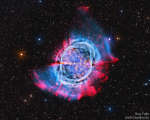 M27: The Dumbbell Nebula
12.07.2021
What will become of our Sun? The first hint of our Sun's future was discovered inadvertently in 1764. At that time, Charles Messier was compiling a list of diffuse objects not to be confused with comets.
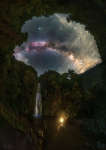 A Waterfall and the Milky Way
1.11.2021
The dream was to capture both the waterfall and the Milky Way together. Difficulties included finding a good camera location, artificially illuminating the waterfall and the surrounding valley effectively, capturing the entire scene with...
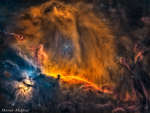 A Lion in Orion
7.03.2022
Yes, but can you see the lion? A deep exposure shows the famous dark indentation that looks like a horse's head, visible just left and below center, and known unsurprisingly as the Horsehead Nebula. The Horsehead Nebula (Barnard 33) is part of a vast complex of dark absorbing dust and bright glowing gas.
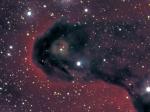 VDB 142 in Cepheus
11.10.2001
A gorgeous collection of dust and gas nebulae in the Northern Milky Way graces the high and far off constellation of Cepheus. With colors based on astronomical filters, this close up of the region highlights stars embedded in curiously shaped cosmic clouds.
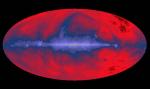 The Radio Sky: Tuned to 408MHz
20.10.2001
Tune your radio telescope to 408MHz (408 million cycles per second) and check out the Radio Sky! You should find that frequency on your dial somewhere between US broadcast television channels 13 and 14.
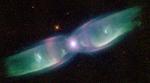 M2 9: Wings of a Butterfly Nebula
17.12.2000
Are stars better appreciated for their art after they die? Actually, stars usually create their most artistic displays as they die. In the case of low-mass stars like our Sun and M2-9 pictured above
 The Blue Snowball Planetary Nebula
21.11.1996
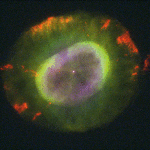
Will the Sun one day look like - a blue snowball? Maybe! The Blue Snowball is a planetary nebula - and in 5 billion years the Sun will throw off its outer layers and go through a planetary nebula phase.
|
January February March April May June July August September October |
|||||||||||||||||||||||||||||||||||||||||||||||||