
|
You entered: color
 The Local Fluff
29.08.2010
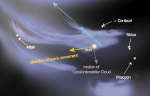
The stars are not alone. In the disk of our Milky Way Galaxy about 10 percent of visible matter is in the form of gas, called the interstellar medium (ISM). The ISM is not uniform, and shows patchiness even near our Sun.
 A Beautiful Trifid
13.05.2011
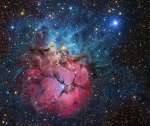
The beautiful Trifid Nebula is a cosmic study in colorful contrasts. Also known as M20, it lies about 5,000 light-years away toward the nebula rich constellation Sagittarius. A star forming region...
 Mercury Spotting
27.05.2012
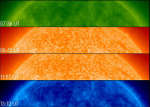
Can you spot the planet? The diminutive disk of Mercury, the solar system's innermost planet, spent about five hours crossing in front of the enormous solar disk in 2003, as viewed from the general vicinity of planet Earth.
 Globular Star Cluster NGC 6752
5.07.2013
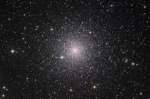
Some 13,000 light-years away toward the southern constellation Pavo, the globular star cluster NGC 6752 roams the halo of our Milky Way galaxy. Over 10 billion years old, NGC 6752 follows clusters Omega Centauri and 47 Tucanae as the third brightest globular in planet Earth's night sky.
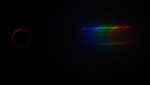 The Flash Spectrum of the Sun
12.03.2016
In a flash, the visible spectrum of the Sun changed from absorption to emission on March 9 during the total solar eclipse. That fleeting moment, at the beginning the total eclipse phase, is captured by telephoto lens and diffraction grating in this image from clearing skies over Ternate, Indonesia.
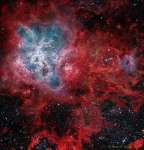 The Cosmic Web of the Tarantula Nebula
8.11.2016
It is the largest and most complex star forming region in the entire galactic neighborhood. Located in the Large Magellanic Cloud, a small satellite galaxy orbiting our Milky Way galaxy, the region's spidery appearance is responsible for its popular name, the Tarantula nebula. This tarantula, however, is about 1,000 light-years across.
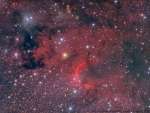 The Light, the Dark, and the Dusty
28.09.2018
This colorful skyscape spans about two full moons across nebula rich starfields along the plane of our Milky Way Galaxy in the royal northern constellation Cepheus. Near the edge of the region's massive...
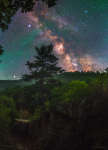 Firefly Milky Way over Russia
6.09.2021
It started with a pine tree. The idea was to photograph a statuesque pine in front of the central band of our Milky Way Galaxy. And the plan, carried out two months ago, was successful -- they both appear prominently. But the resulting 3-frame panorama captured much more.
 The Double Cluster in Perseus
8.10.2021
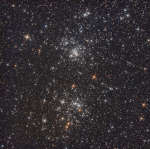
This pretty starfield spans about three full moons (1.5 degrees) across the heroic northern constellation of Perseus. It holds the famous pair of open star clusters, h and Chi Persei. Also cataloged...
 Xuyi Station and the Fireball
6.12.2024
Colorful and bright, this streaking fireball meteor was captured in a single exposure taken at Purple Mountain (Tsuchinshan) ObservatoryБs Xuyi Station in 2020, during planet Earth's annual Perseid meteor shower. The dome in the foreground houses the China Near Earth Object Survey Telescope (CNEOST), the largest multi-purpose Schmidt telescope in China.
|
January February March April May June July August September October |
|||||||||||||||||||||||||||||||||||||||||||||||||